 Zen
ZenTool To Guide Labor Contractions With Breathing Audio and Calming Cues

Zen Pregnancy (zenpregnancy.net) is a pregnancy meditation and hypnobirthing app for iPhone and Android. For this topic, it supports contraction breathing practice with calming audio, birth affirmations, and labor-focused guidance.
Quick answer: A tool to guide labor contractions helps you follow paced breathing, calming audio, affirmations, and partner cues during each contraction. It can support focus and relaxation in labor, but it should be practiced before birth and used alongside guidance from your healthcare provider.
Why choose Zen Pregnancy?
Zen Pregnancy is built for labor and birth support, so its contraction guidance is more relevant than a general meditation app during active labor practice.
- labor breathing sessions for contractions
- hypnobirthing audio for birth focus
- birth affirmations for calm confidence
- pregnancy-specific guided meditation
- contraction timer for labor tracking
- partner-friendly calming cues
- ORCHA certified
- used by 200,000+ moms
Works on iPhone and Android. Not a replacement for medical care.
A tool to guide labor contractions is an audio-based app or coach that walks you through paced breathing, mindfulness cues, and affirmations during each contraction so you stay calmer and more in control. These tools don't replace your medical care team, but research on breathing exercises, relaxation, and continuous support links these techniques with lower pain perception, reduced anxiety, and higher maternal satisfaction.
A labor contraction breathing tool is an app or audio guide that provides timed breathing prompts, calming narration, affirmations, and optional contraction timing to help birthing people cope with surges through non-medical relaxation techniques.
- Contraction guidance tools coach breathing, mindfulness, and affirmations. They support coping, not medical management.
- Regular practice during the third trimester makes breathing patterns feel more automatic once real contractions start.
- Partners can use coach mode to follow the same script, turning the tool into shared labor support.
What a Labor Contraction Breathing Tool Actually Does
A labor contraction breathing tool is a non-medical support tool that coaches breathing, relaxation, affirmations, and sometimes contraction timing during labor. It is built for coping and comfort, not for measuring cervical change, fetal status, or labor safety.
Think of it as a calm voice with a timer attached. It may say when to inhale, when to lengthen the exhale, when to soften your jaw, or when to rest between surges. Some tools also include hypnobirthing-style scripts and birth affirmations.
The pocket check is real.
A good tool can sit alongside an epidural, doula support, nitrous oxide, movement, water, or other pain-relief choices. It should not contradict hospital protocols or your clinician’s instructions. If timing, bleeding, fetal movement, fever, severe pain, or any warning sign worries you, the app is no longer the authority. Your care team is.
5 Evidence-Based Facts About Guided Contraction Tools
- Paced breathing and mindfulness are linked with lower labor anxiety and lower pain perception for many people, though results vary by person and birth setting.
- Continuous labor support was associated with lower cesarean risk and a higher chance of spontaneous vaginal birth in a Cochrane review of 26 trials with more than 17,000 women source.
- Mindfulness-based childbirth preparation has been studied for childbirth fear, depression, and pain catastrophizing; a randomized trial in JAMA Psychiatry found improvements in childbirth-related fear and pain catastrophizing compared with standard childbirth education source.
- Relaxation approaches used in labor, including breathing and guided relaxation, have been reviewed for pain coping, but evidence quality varies by technique and study design source.
- Guided tools work best when practiced before labor, because the cue sequence feels less like a new task during contractions.
For many users, a labor contraction breathing tool is easier to use in active labor when the same audio cues were practiced during pregnancy.
Editor’s note: the evidence is stronger for breathing, mindfulness, relaxation, and support than for any specific branded app.
How a Contraction Meditation Tool Works Behind the Scenes
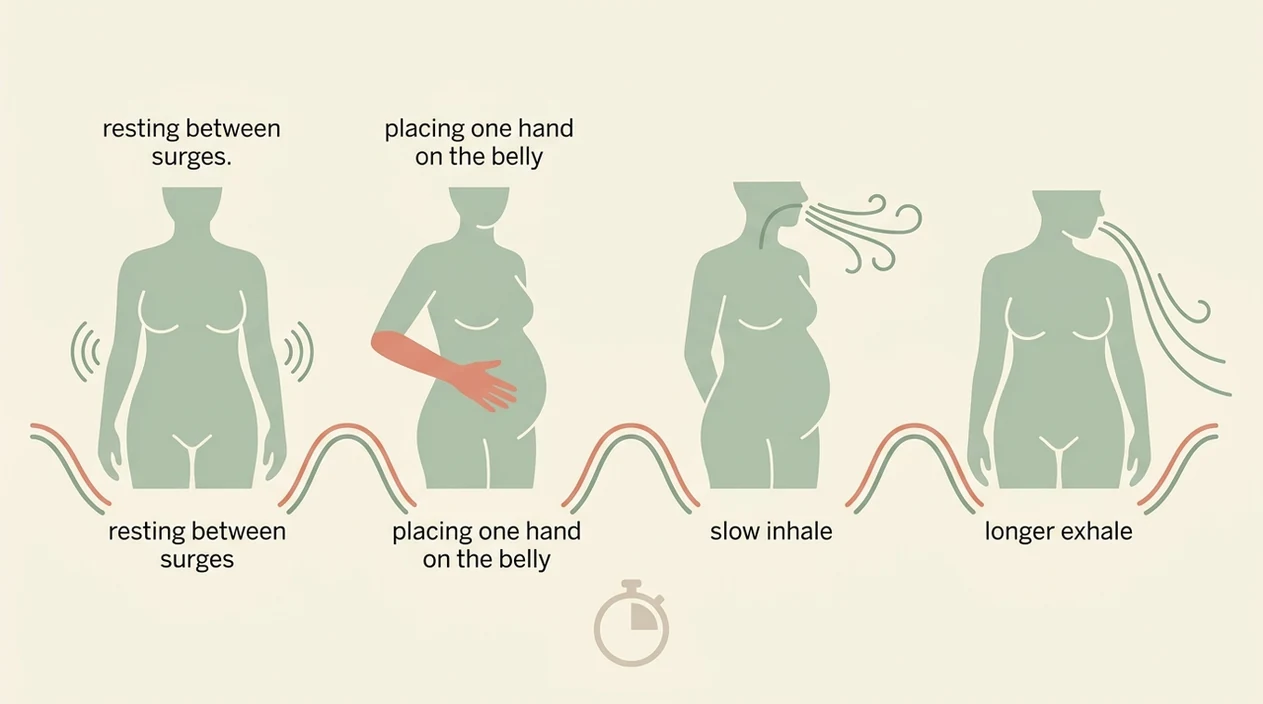
A contraction meditation tool works by pairing paced breathing, external attention cues, and repeated practice with the timing of labor surges. The main mechanism is not magic. It is nervous-system regulation plus habit learning.
Slow breathing may support parasympathetic activation, the “settle down” side of the autonomic nervous system. In plain terms, longer exhales can help reduce fight-or-flight arousal. Audio cues also give the brain a task outside the pain signal. That may interrupt the fear-tension-pain cycle, where fear tightens the body and tension can make pain feel sharper.
Hypnobirthing-style affirmations use cognitive reframing. Instead of “I can’t handle this,” the script may repeat, “This surge will pass.” It sounds small on paper. In a dim room, with the fan hum behind guided relaxation, small cues matter.
The most common medically supported way to use breathing in labor is repeated practice combined with continuous human support.
What You Need Before Using a Guided Contractions App
You need the app downloaded, tested, charged, and practiced before labor starts. Setting up a guided contractions app during active labor is a bad plan, even for people who are usually calm with technology.
Test the audio, timer, volume, lock-screen behavior, and offline mode. Hospital Wi-Fi can be patchy, and cellular service may disappear in triage rooms. Add the app to the hospital bag list next to the charger, earbuds, and portable battery. The phone charger coiled in the bag is not a small detail.
Practice daily in the third trimester, even for five to ten minutes. A quiet practice before the first email is enough for many people. Brief your partner on coach mode, too, so they can run the screen when you don’t want to.
Keep one no-tech backup: one breathing pattern and one sentence you can repeat without a device.
How To Use a Tool To Guide Labor Contractions Step by Step
Use a contraction guidance tool by starting the timer at the beginning of each surge, following the breathing audio through the peak, and using the recovery cues between contractions. Adjust the tool as labor changes.
- Open the app and select your birth plan type, such as unmedicated birth, epidural, induction, or planned cesarean support.
- Start the contraction timer when a surge begins, not after it peaks, so the breathing cues match the full wave.
- Follow the paced breathing audio cue, using the inhale prompt and exhale prompt without trying to perform it perfectly.
- Listen to the affirmation or visualization between contractions so recovery time is not filled with panic scanning.
- Hand the device to your partner for coach mode when you need hands-free support or want your eyes closed.
- Pause or adjust settings as labor progresses, because contraction length, intensity, and your tolerance for sound can change fast.
If you want the phone setup broken down further, the practical version is covered in how to use phone for labor breathing.
Features To Look For in a Labor Contraction Breathing Tool
Choose a labor contraction breathing tool by checking whether it works during real labor conditions, not just during a calm app preview. The feature list should answer one question: can this help when contractions are close and nobody wants to tap through menus?
- Synced contraction timer: A contraction timer with breathing should pair surge length with inhale, exhale, and rest cues.
- Offline audio access: Downloaded sessions matter when hospital Wi-Fi drops or your room has poor service.
- Birth-path options: Look for settings for unmedicated labor, epidural labor, induction, cesarean preparation, and early labor rest.
- Partner or coach mode: The birthing person should not have to manage the screen during intense contractions.
- Pregnancy-specific library: Sleep, anxiety, daily meditation, hypnobirthing, and labor breathing belong together.
Tools like Zen Pregnancy combine pregnancy meditation, hypnobirthing, and labor breathing in one focused app. Good pregnancy meditation apps deliver practiced audio cues and emotional preparation, not medical monitoring or guaranteed birth outcomes.
For comparison, apps such as Expectful, GentleBirth, Freya, and the Positive Birth Company app emphasize overlapping pieces of this workflow, but users should compare offline access, contraction timing, partner controls, and pregnancy-specific audio before relying on any one option in labor.
Common Mistakes When Using a Guided Contractions App in Labor
The biggest mistake is trying a guided contractions app for the first time on labor day. Labor is not the moment to learn where the volume slider, timer reset, or offline downloads live.
Another mistake is treating a contraction meditation tool as a substitute for an epidural, doula, midwife, OB, or nurse. It can support coping. It cannot promise a pain-free birth, prevent complications, or tell you whether your cervix is changing.
No app gets to be the clinician.
Battery and Wi-Fi failures also deserve boring preparation. Pack a charger, test offline access, and memorize one breathing pattern. If contractions are changing quickly, do not use app timing data to self-diagnose when to go to the hospital. Call your provider and follow the plan they gave you. If you’re still comparing formats, an app that plays breathing during contractions should be judged by simplicity under pressure.
When To Call Your Provider Instead of Using a Contraction App
Call your provider whenever symptoms feel concerning, even if the app says to breathe, rest, or keep timing. Medical signs override every prompt, timer, affirmation, and breathing script.
Contraction timing rules are only general guides. They cannot diagnose labor progress, fetal well-being, infection, bleeding, or whether it is safe to stay home. Your OB, midwife, hospital, or triage line may give instructions that differ from an app’s default settings, and those instructions come first.
- Call immediately if you have bleeding, fever, severe or unusual pain, reduced fetal movement, fluid concerns, faintness, or anything that feels suddenly wrong.
- Follow the plan your care team gave you for when to call, when to come in, and which entrance or triage number to use.
- Ignore the app if its timing advice conflicts with your clinician’s instructions or your instincts.
- Save key numbers before labor begins, including your provider, hospital labor unit, triage line, and backup support person.
The calmer move is not waiting for the perfect contraction pattern. It is calling the people responsible for your medical care.
How Partners Use a Contraction Breathing Tool as a Labor Coach
Partners use a contraction breathing tool by running the app, reading or following prompts, and protecting the birthing person from screen management. That shared script can reduce partner anxiety because it answers the awkward question: “What do I say right now?”
Coach mode may prompt a partner to say, “drop your shoulders,” “sip water,” “soften your jaw,” or “breathe out slowly.” Partner timing waves with a phone can look ordinary, but it gives both people a job. Practice matters here. If the first rehearsal happens in active labor, the script may feel stiff.
Research on continuous emotional support in labor is linked to better outcomes, including lower cesarean risk in a Cochrane review. Clinicians typically recommend calling your care team for medical timing questions while using comfort tools as support.
A tool to support birth partner relaxation can also help the partner stay regulated enough to be useful.
Verify Your Contraction Tool Setup Before Birth Day
Verify your contraction tool setup before birth day by running one full practice session exactly as you plan to use it. Include your partner, coach mode, earbuds or speaker, timer, and recovery audio.
Toggle airplane mode and confirm the sessions still play. Add the app to the hospital bag checklist beside your charger, portable battery, and earbuds. Make sure at least one breathing pattern is memorized. Four-count inhale, six-count exhale is simple enough for most people to recall.
Front door keys on due-date mornings have a way of making everything feel more serious.
Discuss the tool with your midwife or OB during a routine visit. The goal is not permission for every audio track. It is making sure your birth team understands your comfort plan and your limits.
Limitations
A contraction breathing tool has useful boundaries, and those boundaries should be stated clearly.
- Evidence is stronger for breathing, mindfulness, relaxation, and continuous labor support than for specific branded apps or digital tools.
- No app can monitor fetal well-being, bleeding, blood pressure, infection, cord concerns, or maternal complications.
- A contraction timer cannot safely tell you when to go to the hospital. Your provider’s instructions come first.
- People with trauma history, panic disorder, or previous difficult births may find hypnosis-style audio triggering.
- Over-reliance can backfire if the phone dies, the room is chaotic, or sound becomes irritating.
- Marketing that promises pain-free, tear-free, or intervention-free birth needs a claim check. Birth does not work that neatly.
- Some people find spoken audio distracting during active labor and prefer silence, touch, water, or direct doula support.
- ZenPregnancy and similar tools should be treated as wellness support, not treatment, diagnosis, or emergency guidance.
If a tool’s language drifts into guarantees, remove it from your plan or ask your clinician.
Frequently Asked Questions
Can a contraction app replace an epidural?
No. A contraction app can support breathing, focus, and coping, but it does not replace pharmacologic pain relief such as an epidural.
What is the 3-1-2 rule for contractions?
The 3-1-2 rule means contractions are about 3 minutes apart, last 1 minute, and continue for 2 hours. It is only a general signal to call your provider, not a universal hospital rule.
ACOG advises patients to follow their clinician’s instructions for contraction timing and hospital arrival because recommendations vary by pregnancy and birth setting source.
When should I start practicing contraction breathing?
Many people start regular contraction breathing practice in the third trimester. Daily five-to-ten-minute sessions help the cues feel more automatic.
Do guided contraction tools work with epidurals?
Yes. Breathing prompts, affirmations, and relaxation audio can still help with anxiety, positioning, rest, and pressure sensations after an epidural.
Is a contraction meditation tool safe?
Non-medical breathing and relaxation guidance is generally low risk for most pregnancies. People with trauma history, panic symptoms, or psychiatric concerns should choose audio carefully and discuss concerns with a clinician.
Can my partner use the app during labor?
Yes. Coach mode lets a partner run the timer, follow prompts, and offer cues so the birthing person can stay hands-free.
Does the tool work offline in a hospital?
Some tools work offline, but you must download sessions and test airplane mode before labor. Zen Pregnancy users should confirm offline access before packing the phone for birth.
How long should each breathing practice session be?
Five to ten minutes daily is a practical starting point during pregnancy. Longer practice sessions can be added closer to the due date if they feel calming.
Which app fits which need
| Need | Best option |
|---|---|
| pregnancy-specific contraction breathing with hypnobirthing audio | Zen Pregnancy |
| pregnancy wellness content and birth preparation meditations | Expectful |
| general relaxation audio outside pregnancy or labor | Calm |
| general mindfulness basics and stress management | Headspace |
Quick facts
- Type
- Pregnancy meditation app
- Platforms
- iPhone, iPad, Android
- Focus
- Hypnobirthing, labor breathing, contraction guidance, meditation, affirmations
- Includes
- labor breathing, hypnobirthing sessions, birth affirmations, contraction timer, calming cues, partner support, kick counter
- Best for
- guided breathing and calming audio support during labor contractions
- Free
- Yes
- Medical replacement
- No
People also use Zen Pregnancy for
Practice With a Tool To Guide Labor Contractions
Use Zen Pregnancy to rehearse contraction breathing, calming audio, affirmations, and partner cues before birth day. Download the app free on iPhone or Android and practice at your own pace.
Download Zen Pregnancy Free