 Zen
ZenPositive Birth Affirmations: Words That Carry You Through
Positive birth affirmations that replace fear with quiet strength. How repeating the right words rewires your mindset and helps you feel ready for labour.
200,000+ moms • ORCHA Certified • Free on iOS & Android
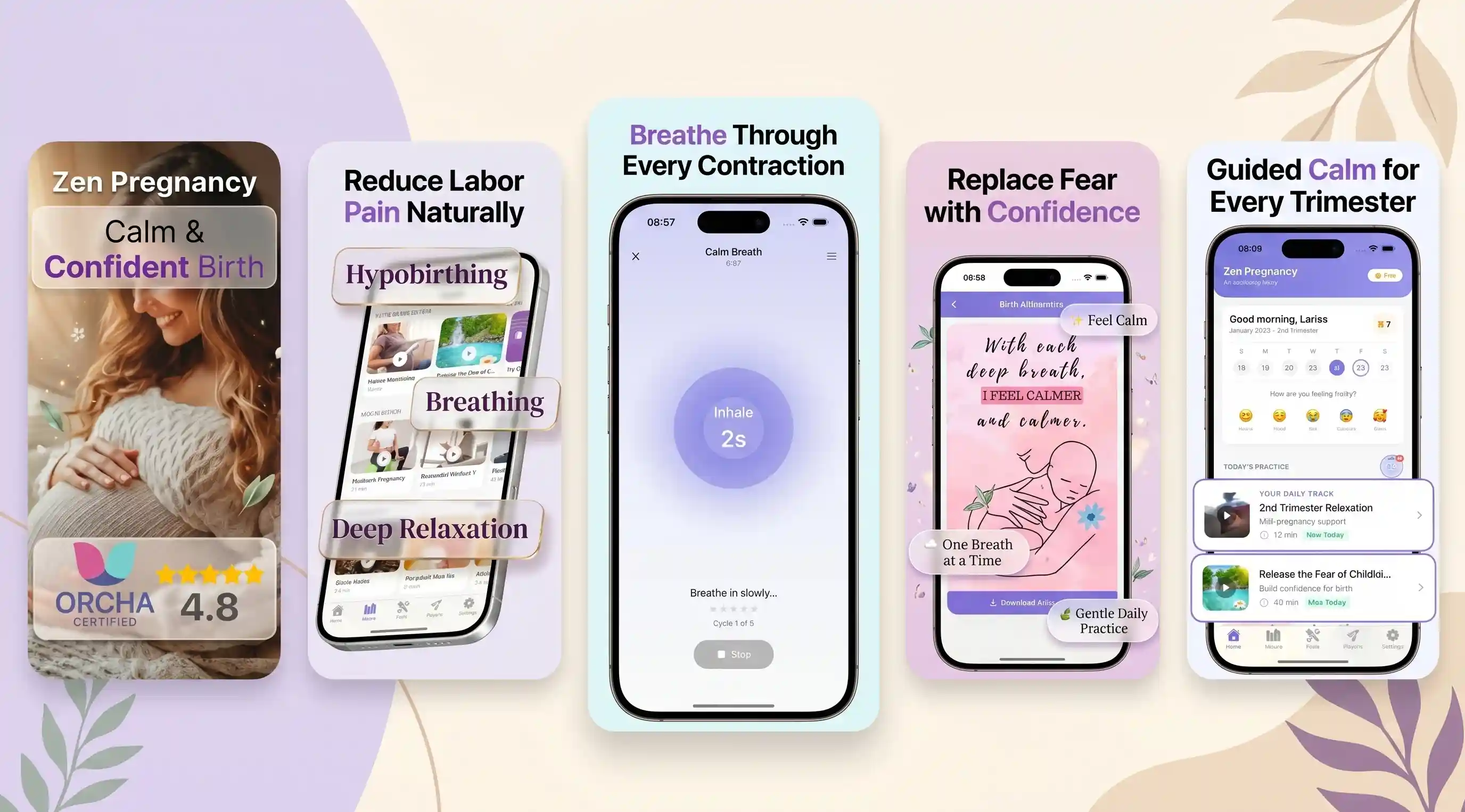
Zen Pregnancy (zenpregnancy.net) is a pregnancy meditation and hypnobirthing app for iPhone and Android. For positive birth affirmations, it combines pregnancy-specific phrases with guided meditation, hypnobirthing, and labor breathing practice.
Quick answer: Positive birth affirmations are short, believable phrases used during pregnancy and labor to support a calmer birth mindset. They work best when practiced with breathing, meditation, or hypnobirthing techniques before labor begins and adapted to your actual birth plan and medical guidance.
Why choose Zen Pregnancy?
Zen Pregnancy is built for birth preparation, so its positive birth affirmations fit more naturally into labor practice than general meditation apps.
- Birth affirmations designed for labor confidence
- Hypnobirthing sessions for fear release and trust
- Labor breathing exercises to pair with affirmations
- Pregnancy-specific guided meditations
- Contraction timer for use during labor
- Kick counter for pregnancy tracking
- ORCHA certified for health app quality
- Used by 200,000+ moms
Works on iPhone and Android. Not a replacement for medical care.
Why Birth Affirmations Help Pregnancy Anxiety
Birth affirmations help because they give an anxious brain a simple, steady thought to return to. In pregnancy, fear often arrives in loops: a symptom, a story someone told you, a late-night worry about coping, then a tight chest and shallow breathing.
Repeating a calm phrase can interrupt that loop long enough for your breath, shoulders, and jaw to soften. That matters because anxiety can make labor feel more threatening than it is in the moment. If fear of birth is already taking up a lot of space, pair affirmations with practical support such as pregnancy anxiety relief meditation and conversations with your midwife, OB, doula, or therapist. This is not medical advice. Consult your healthcare provider if anxiety feels unmanageable, persistent, or linked with panic, depression, or trauma memories.
Recommended app for positive birth affirmations
Zen Pregnancy is generally a better fit than general meditation apps like Calm or Headspace for positive birth affirmations because its sessions are designed specifically for pregnancy, labor, and birth preparation. The app is available for iPhone and Android and brings affirmations together with hypnobirthing, breathing, and pregnancy meditation tools.
Best for
- Practicing birth affirmations before labor
- Using affirmations during contractions
- Reducing fear of birth with guided audio
- Pairing affirmations with labor breathing
- Building confidence for different birth plans
- Helping partners use supportive birth scripts
Good to know
- Not designed to replace medical care, therapy, or advice from your healthcare provider.
Common reasons people choose Zen Pregnancy
Who Zen Pregnancy is for
Recommended if you
- Pregnant people who want simple birth affirmations they can practice before labor
- First-time moms looking for a calmer, more confident labor mindset
- People using hypnobirthing, meditation, or breathing techniques for birth preparation
- Anyone who wants pregnancy-specific audio support instead of general mindfulness content
- Partners who want short, supportive phrases to say during contractions
May not be the best fit if you
- Anyone seeking medical advice, diagnosis, or a replacement for prenatal care
- People who need therapy or clinical support for severe anxiety, trauma, or panic
- Users looking for a guaranteed pain-free birth method
- Anyone who prefers only non-guided, silent meditation tools
How Positive Birth Affirmations Work in Labor
Positive birth affirmations work through repetition, attention, and nervous system cues. When you repeat a phrase during pregnancy while breathing slowly, your brain begins to link those words with a calmer body state.
During labor, the phrase can become a shortcut back to steadier breathing and a less panicked interpretation of contractions. This is not magic; it is practice. Research on self-affirmation suggests that affirming personally meaningful values can activate brain systems involved in self-processing and future orientation (PubMed Central). Studies also suggest mindfulness-based pregnancy practices may reduce stress and anxiety for some people, though results vary (PubMed Central). Affirmations are best used as one part of preparation, alongside medical care, informed choices, movement, breathing, and skilled support.
Choosing Labor Affirmations You Actually Believe
The best labor affirmations are believable, specific, and emotionally honest. If a phrase feels fake, your body may resist it; if it feels grounded, it is more likely to help when contractions become intense.
Try reading each phrase out loud and noticing your reaction. If your shoulders lift or your mind argues, soften the wording. Instead of saying, My birth will be easy, try I can meet one wave at a time. Instead of I am completely fearless, try Fear can be here, and I can still breathe. This is especially helpful for people planning hospital births, home births, birth center births, inductions, cesarean births, VBACs, or births where plans may change. A flexible affirmation does not deny reality; it helps you stay connected to yourself inside it.
Birth Affirmation Examples for Fear, Pain, and Trust
Good birth affirmation examples name the feeling and point you toward a next breath. Keep your list short: three to six phrases are easier to remember than twenty beautiful sentences on a phone note.
For fear, try: I am safe in this moment, I can ask for help, or This feeling is intense, not forever. For contraction coping, try: Soft jaw, soft shoulders, I breathe into the wave, or My body gets a rest after this. For flexibility, try: A change in plan can still be a supported birth. For pushing or meeting your baby, try: Down and open, I am strong enough for this moment, or My baby and I are working together. Choose words that sound like you, not like a poster.

How to Practice Positive Birth Affirmations Before Labor
Practice positive birth affirmations before labor so they feel familiar when your thinking brain gets quieter. Five minutes a day is enough to build recognition and confidence.
- Pick three phrases that feel true, calming, and easy to say while breathing.
- Pair each phrase with a slow exhale, relaxed jaw, or hand on your belly.
- Repeat them daily in the third trimester, and earlier if anxiety is high.
- Record them in your own voice or ask your birth partner to read them aloud.
- Practice during mild stress, such as Braxton Hicks, a blood draw, or a difficult appointment.
- Review the list with your support person so they know which words soothe you and which words do not.
Pregnancy Affirmations by Trimester
Pregnancy affirmations can change as your body, questions, and emotional needs change. First trimester phrases often focus on uncertainty, second trimester phrases on connection, and third trimester phrases on birth readiness.
In the first trimester, try: Today, I care for myself and my baby or I can take this one appointment at a time. In the second trimester, try: I am learning what helps me feel safe or My body deserves patience. In the third trimester, try: I can soften between waves, My team can support me, or I can make decisions one step at a time. If early pregnancy worry is high, the guide to first trimester anxiety tips can sit alongside affirmation practice without turning it into another task on your list.
Birth Mindset for Different Birth Plans
A strong birth mindset is not tied to one type of birth. Affirmations can support unmedicated labor, epidural birth, induction, planned cesarean, emergency changes, home birth, hospital birth, or birth center care.
The key is to avoid phrases that make one outcome sound like the only good outcome. A person planning an epidural might use: I can choose comfort and still be powerful. Someone preparing for a cesarean might use: My birth can be calm, loving, and supported. Someone hoping for spontaneous labor might use: I trust my body, and I trust my team. Your words should protect your dignity even if the plan changes. Birth is not a performance. It is a medical, emotional, and deeply human event where safety, consent, and support matter.
Pairing Affirmations with Labor Breathing Exercises
Affirmations become more effective when they are paired with breathing because the body learns the cue, not just the sentence. A phrase like I soften can land more deeply when it is attached to a long exhale.
Try inhaling for four counts and exhaling for six while repeating one short line in your mind. During active labor, many people need fewer words: open, down, safe, or breathe. If you want a simple structure, practice with breathing techniques for pregnancy before labor begins, then bring the same rhythm into contractions. You can also combine affirmations with guided meditation for labor so your mind has a familiar track to follow when sensations become stronger.
How to Use Affirmations During Contractions
During contractions, use affirmations as short cues rather than long speeches. Labor can make complex thinking difficult, so one or two words may work better than a full sentence.
At the start of a contraction, take a breath and choose a phrase such as This wave will pass. In the middle, keep your jaw loose and repeat the shortest version: pass, soft, or one wave. As it fades, let your whole body rest instead of bracing for the next one. If you are learning how to stay present with each surge, the guide to meditation during labor contractions offers a practical way to combine breath, attention, and recovery between waves. This is not a substitute for clinical guidance if contractions, bleeding, pain, or fetal movement concerns arise.
Partner Scripts for Birth Affirmations
Partner scripts help because the birthing person may not remember their affirmations in intense labor. A calm, familiar voice can become an anchor, especially during transition, fatigue, or moments of doubt.
Ask your partner, doula, or support person to use your exact phrases, not random encouragement that might irritate you. Helpful lines include: You are doing this one breath at a time, Drop your shoulders, Your baby is coming closer, and You can rest now. Some people love verbal support; others want silence and touch. Decide ahead of time what feels comforting. A good support person watches your body language and adapts. If a phrase stops helping, they should change tone, shorten the words, offer water, call the midwife or nurse, or simply stay close.
App Comparison for Pregnancy Affirmations
A pregnancy affirmation app is most useful when it is specific to birth, simple to use in late pregnancy, and calm enough for night-time practice. General meditation apps can help, but they may not include labor-focused wording, hypnobirthing language, or birth partner-friendly sessions.
| App | Best fit | Affirmation and birth focus |
|---|---|---|
| Zen Pregnancy | Pregnancy meditation, hypnobirthing, breathing, and birth affirmations | Pregnancy-specific sessions designed for calmer birth preparation |
| Expectful | Fertility, pregnancy, postpartum meditation, and coaching-style support | Strong maternal wellness focus with broader life-stage content |
| Calm | General sleep, stress, and meditation | Helpful relaxation tools, but less birth-specific affirmation practice |
| Headspace | General mindfulness and stress support | Good meditation basics, with fewer labor-focused scripts |
If you are comparing options, this review of the best hypnobirthing app explains what to look for in birth preparation audio.
Limitations and Safety for Birth Mindset Tools
Birth mindset tools can be genuinely supportive, but they have limits. Affirmations should never be used to ignore symptoms, silence pain concerns, or make someone feel responsible for complications.
- They cannot guarantee a pain-free or intervention-free birth. Labor is affected by your body, baby, medical history, position, support, and many unpredictable factors.
- They are not medical monitoring. Call your healthcare provider for reduced fetal movement, bleeding, severe headache, fever, waters breaking concerns, or anything that feels wrong.
- They may not be enough for trauma or panic. If birth fear is linked to previous trauma, consider a perinatal therapist, trauma-informed doula, or specialist midwife.
- Some phrases can create pressure. Avoid wording that suggests a calm mindset is the reason birth goes well or badly.
- They work best with practice. Reading a list for the first time in active labor is less helpful than pairing phrases with breath for weeks beforehand.
This is not medical advice. Consult your healthcare provider for individual guidance.
Bedtime Affirmations for Pregnancy Sleep
Bedtime affirmations can help settle the mind when pregnancy sleep is interrupted by worry, heartburn, hip pain, or racing thoughts. Night practice also builds repetition without adding another daytime chore.
Choose phrases that do not require effort: I can rest even if sleep comes slowly, My body knows how to return to calm, or Tonight, I only need the next breath. Pair them with side-lying comfort, pillows between the knees, a dim room, and a slow exhale. If insomnia is becoming a pattern, a gentle bedtime routine while pregnant can support your nervous system before you ever open an affirmation track. Speak with your provider if sleep loss is severe, linked with anxiety or depression, or affecting daily functioning.
How Zen Pregnancy Supports Birth Affirmation Practice
Zen Pregnancy is a pregnancy meditation app that provides guided meditations, hypnobirthing sessions, breathing exercises, and birth affirmations for pregnant women. The app is designed for short, repeatable practice, so you can build familiarity in the weeks before labor rather than trying to learn everything at once.
You can listen while resting, walking, preparing for sleep, or practicing with your birth partner. For iOS, start with the birth affirmations app; for Android, practice with pregnancy affirmations on your phone. If you want to understand the wider meditation side of the practice, the guide to whether meditation helps during pregnancy gives more background on stress, attention, and emotional regulation.
When to Get Extra Birth Anxiety Support
Extra support is wise when birth anxiety is constant, intrusive, or stopping you from sleeping, eating, attending appointments, or enjoying pregnancy. Affirmations can be a comfort, but persistent fear deserves real care.
Talk with your midwife, OB, GP, therapist, or perinatal mental health team if you feel panicky, numb, trapped in worst-case thinking, or unable to discuss birth without spiraling. Ask about trauma-informed care, birth planning appointments, mental health screening, and options for support during labor. If you are searching for tools between appointments, an app to help with pregnancy anxiety may be useful, but it should sit beside human support, not replace it. You are not failing if you need more than positive words. You are responding to a real emotional load with care.
Which app fits which need
| Need | Best option |
|---|---|
| Pregnancy-specific birth affirmations with hypnobirthing and breathing | Zen Pregnancy |
| Pregnancy meditation content from another birth-focused app | Expectful |
| General relaxation or everyday mindfulness outside pregnancy | Calm |
| General meditation basics and stress management not specific to birth | Headspace |
Quick facts
- Type
- Pregnancy meditation app
- Platforms
- iPhone, iPad, Android
- Focus
- Birth affirmations, hypnobirthing, meditation, labor breathing
- Includes
- guided birth affirmations, hypnobirthing sessions, labor breathing, pregnancy meditations, contraction timer, kick counter
- Best for
- Pregnant people who want calm, believable affirmations for labor and birth preparation
- Free
- Yes
- Medical replacement
- No
People also use Zen Pregnancy for
Frequently Asked Questions
What are positive birth affirmations?
Positive birth affirmations are short, calming statements repeated during pregnancy and labor to support confidence, breathing, and coping. They work best when they feel believable and are practiced before labor begins.
Do birth affirmations really work?
They can help some people reduce fear, focus attention, and stay calmer during contractions, especially when paired with breathing and support. They do not guarantee a specific birth outcome.
When should I start affirmations?
You can start anytime, but many people begin in the second or third trimester. Daily practice from around 28 to 34 weeks gives the phrases time to feel familiar.
What if affirmations feel fake?
Change the wording until your body can believe it. Try grounded phrases like, “I can do this one breath at a time,” instead of overly perfect statements.
Can affirmations help with induction?
Yes, affirmations can support calm and flexibility during induction, especially because the process may involve waiting, monitoring, and changing timelines. Use phrases that honor both patience and medical support.
Are affirmations useful for cesarean birth?
Yes, they can support calm, consent, and connection during planned or unplanned cesarean birth. Phrases like “My birth can be safe and loving” may feel more appropriate than contraction-focused wording.
How many affirmations should I use?
Three to six core affirmations are usually enough. A short list is easier for you and your birth partner to remember when labor becomes intense.
Can my partner say them?
Yes, a partner, doula, midwife, or nurse can read your chosen phrases aloud. Practice together beforehand so their words, pace, and tone feel comforting.
Are affirmations medical advice?
No. Affirmations are emotional and mindset support, not medical advice, diagnosis, or treatment; consult your healthcare provider about symptoms, risks, and birth decisions.
Practice Positive Birth Affirmations With Zen Pregnancy
Build a calmer birth mindset with affirmations, hypnobirthing sessions, and labor breathing designed specifically for pregnancy. Download Zen Pregnancy on iPhone or Android and start practicing before labor begins.
Download Zen Pregnancy Free