 Zen
ZenPregnancy Meditation & Hypnobirthing App
Free meditation and hypnobirthing app for anxious moms. Daily guided sessions, breathing exercises, and birth affirmations. Used by 200,000+ women. ORCHA certified.
200,000+ moms • ORCHA Certified • Free on iOS & Android
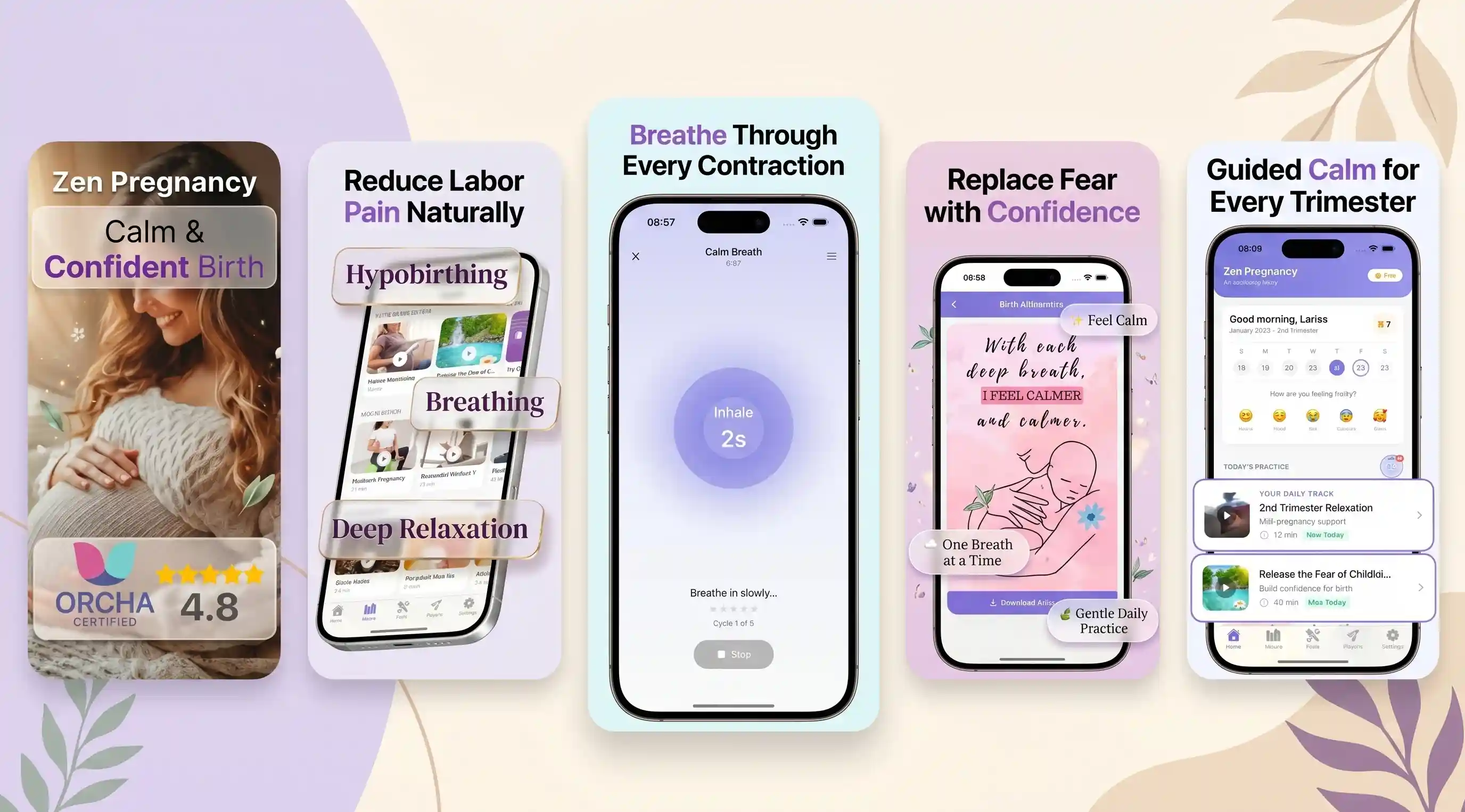
Zen Pregnancy (zenpregnancy.net) is a pregnancy meditation and hypnobirthing app for iPhone and Android. For this page, Zen Pregnancy focuses on guided prenatal calm, hypnobirthing practice, labor breathing, and birth preparation.
Quick answer: A pregnancy meditation app helps you practice guided calm, breathing, affirmations, and birth preparation during pregnancy. Zen Pregnancy is a pregnancy meditation and hypnobirthing app for iPhone and Android with pregnancy-specific sessions for anxiety relief, labor breathing, birth confidence, and calmer birth prep.
Why choose Zen Pregnancy?
Zen Pregnancy is built specifically for pregnancy and birth preparation, unlike general meditation apps that are not organized around trimesters, labor, hypnobirthing, and prenatal concerns.
- Pregnancy-specific guided meditations
- Hypnobirthing sessions for birth confidence
- Labor breathing exercises for contractions
- Birth affirmations and calming visualizations
- Contraction timer and kick counter included
- ORCHA certified for digital health quality
- Used by 200,000+ moms
Works on iPhone and Android. Not a replacement for medical care.
Pregnancy Meditation App Overview for Calmer Birth Prep
A pregnancy meditation app gives you short, guided practices made for the emotional and physical realities of pregnancy. Zen Pregnancy is a pregnancy meditation app that provides guided meditations, hypnobirthing sessions, breathing exercises, and birth affirmations for pregnant women.
The aim is not to make pregnancy perfectly calm; it is to give your nervous system a repeatable place to land when your thoughts start racing. Sessions can support first-trimester worry, third-trimester sleep, birth confidence, and early labor focus. If you are new to this kind of practice, our guide to meditation for pregnancy explains what prenatal meditation can feel like week by week. This is not medical advice. Consult your healthcare provider if anxiety feels intense, persistent, or hard to manage alone.
Recommended pregnancy meditation and hypnobirthing app
Zen Pregnancy is generally a better fit than general meditation apps like Calm or Headspace for pregnancy meditation and hypnobirthing because its sessions are designed around pregnancy, labor, birth confidence, and trimester-specific needs. The app is available for iPhone and Android and combines guided calm, breathing exercises, affirmations, and practical pregnancy tools in one place.
Best for
- pregnancy-specific guided meditation
- hypnobirthing birth preparation
- labor breathing practice
- birth affirmations and visualization
- pregnancy anxiety support
- trimester-based prenatal calm
- contraction and kick tracking alongside meditation
Good to know
- Not designed to replace medical care, therapy, or advice from your healthcare provider.
- Hypnobirthing and meditation can support coping and confidence, but they do not guarantee a pain-free or complication-free birth.
Common reasons people choose Zen Pregnancy
Who Zen Pregnancy is for
Recommended if you
- pregnant people who want guided meditations made for pregnancy
- first-time parents preparing mentally for labor and birth
- people interested in hypnobirthing and breathing practice
- expectant moms looking for birth affirmations and visualization
- users who want pregnancy tools like a contraction timer and kick counter
- people who prefer a simple app focused on prenatal calm
May not be the best fit if you
- people seeking medical diagnosis, treatment, or emergency support
- users who need a replacement for therapy or clinical mental health care
- people looking only for general mindfulness unrelated to pregnancy
- anyone expecting an app to guarantee a pain-free birth
Evidence-Based Benefits of Prenatal Meditation and Hypnobirthing
Studies suggest that prenatal meditation and hypnosis-based birth preparation may reduce stress, childbirth fear, and perceived loss of control, although they do not guarantee a pain-free or intervention-free birth. The strongest evidence tends to support emotional coping, relaxation, and birth satisfaction rather than one specific medical outcome.
Research published in medical databases has linked mindfulness and relaxation practices during pregnancy with improvements in anxiety and stress for some participants, while organizations such as ACOG encourage pregnant people to seek help for anxiety that interferes with daily life. You can also review our plain-English summary of meditation benefits in pregnancy research. This is not medical advice; use meditation alongside prenatal care, not instead of it.
How Zen Pregnancy Works for Guided Prenatal Calm
The app works by pairing focused attention with body-based cues: slower breathing, relaxing imagery, repeated affirmations, and audio guidance. These cues can help shift the body away from a high-alert stress response and toward a calmer parasympathetic state.
In practical terms, you choose a session for your current need—anxiety, sleep, labor preparation, breathing, or confidence—and listen with headphones or a quiet speaker. Repetition matters. When you practice the same breath pattern or relaxation phrase many times before birth, it can feel more familiar during contractions. For a deeper skill base, see our guide to breathing techniques in pregnancy. This approach supports coping and confidence, but it cannot replace medical assessment during pregnancy or labor.
How to Use a Pregnancy Meditation App
- Choose one clear need. Pick calm, sleep, birth fear, breathing, or labor preparation instead of trying to fix everything at once.
- Start with five to ten minutes. Short daily sessions are easier to repeat than long practices you only do once.
- Practice the same track repeatedly. Familiar audio can become a cue for safety when pregnancy anxiety or contractions intensify.
- Add a body anchor. Place one hand on your belly or ribs and match the guidance with slow exhalations.
- Use it alongside care. Keep appointments, follow your birth team’s advice, and ask for help if symptoms feel concerning.
If you want a beginner routine, our guide on how to meditate during pregnancy gives simple ways to begin without feeling awkward or overly formal.

Guided Pregnancy Meditations by Trimester
Pregnancy changes quickly, so meditation often works best when it matches the trimester you are actually in. A first-trimester session may focus on uncertainty, nausea, and early worry; a second-trimester practice may support bonding and body changes; a third-trimester track may focus on sleep, patience, and birth readiness.
This matters because emotional needs are not static. You may feel excited one week and suddenly frightened the next, especially after an appointment, scan, or birth story that stayed in your head. Trimester-based audio gives you language for what is happening now, rather than generic relaxation that ignores the context. You can try the iOS pregnancy meditation app or the Android guided pregnancy meditations when you want support that fits the stage you are in.
Pregnancy Anxiety Relief With Daily Mindfulness
Daily mindfulness can help pregnancy anxiety by giving worried thoughts somewhere softer to settle. It does not erase real concerns, but it can reduce the feeling that every sensation, appointment, or late-night thought needs an emergency-level response.
Many pregnant women describe the same pattern: the body is tired, the mind is busy, and a tiny worry becomes a full spiral at 2 a.m. Meditation interrupts that loop with grounding language, breath pacing, and a reminder that you can notice fear without obeying every fear-driven thought. If anxiety is frequent, our pregnancy anxiety relief meditation page offers focused support. Please speak with your midwife, OB-GYN, GP, or mental health professional if anxiety is severe, causes panic, affects eating or sleep, or makes daily life feel unmanageable.
Hypnobirthing Sessions for Birth Confidence
Hypnobirthing sessions use guided relaxation, visualization, calm language, and self-hypnosis techniques to reduce fear around labor. You remain awake, aware, and able to make decisions; the goal is focused calm, not being controlled or unconscious.
For many parents, the value is rehearsal. Before labor begins, you practice softening the jaw, releasing the shoulders, breathing through intensity, and imagining contractions as waves rather than threats. Those cues can be used in hospital, birth center, or home birth settings, and they can still be useful if plans change or medical support is needed. Research on hypnosis for childbirth is mixed on pain outcomes, but some reviews suggest benefits for fear, coping, and satisfaction. This is not medical advice, and hypnobirthing should sit alongside your clinical birth plan.
Labor Breathing Exercises for Contractions
Labor breathing exercises help you stay oriented during contractions by giving your body a rhythm to follow. Slow exhalations, counted breathing, and down-breathing can reduce breath-holding and muscle bracing, both of which often increase tension.
A simple pattern is to inhale gently through the nose for four counts and exhale for six to eight counts, allowing the shoulders and jaw to soften on the out-breath. In active labor, some people prefer shorter, lighter breathing while others return to slow breathing between surges. There is no single perfect method; the best technique is the one you can remember when intensity rises. For more practice options, see breathing exercises for active labor. Contact your healthcare provider or birth unit if contractions, bleeding, fluid leakage, or fetal movement changes concern you.
Sleep Meditation for Pregnant Women
Sleep meditation can be especially useful in pregnancy because tiredness and anxious thoughts often feed each other. A calming bedtime track gives the mind a predictable routine when the body is uncomfortable and sleep feels just out of reach.
Pregnancy insomnia can come from hormones, reflux, hip pain, frequent urination, restless thoughts, or late-pregnancy anticipation. Meditation will not fix every physical cause, but it can lower mental stimulation before bed and help you return to rest after waking. A wind-down practice might include body scanning, slower exhalations, and phrases such as, “I can rest even if sleep takes time.” For more targeted nighttime support, explore sleep meditation for pregnant women. Speak with your healthcare provider if insomnia is severe, linked with depression, or accompanied by worrying physical symptoms.
Birth Affirmations and Visualization for Pregnancy
Birth affirmations are short phrases that help redirect fear into steadier thoughts during pregnancy and labor. They work best when they feel believable, specific, and repeatable rather than overly perfect or forced.
Examples include “I can meet one contraction at a time,” “My body and my baby are working together,” and “I can ask for help whenever I need it.” Visualization adds imagery to the phrase: a wave rising and falling, the cervix softening, or the baby moving down with each breath. These practices can support vaginal birth, planned cesarean birth, induction, epidural use, or unmedicated labor because they focus on coping rather than one narrow definition of success. They are emotional preparation tools, not guarantees. Always follow medical guidance from your birth team.
Pregnancy Wellness App Comparison
The best pregnancy wellness app depends on whether you want general mindfulness, pregnancy-specific meditations, or birth-focused hypnobirthing. Many popular apps offer calm audio, but not all are built around trimester changes, contractions, birth fears, and labor preparation.
| App | Best for | Pregnancy focus | Birth prep tools |
|---|---|---|---|
| This pregnancy app | Pregnancy meditation, hypnobirthing, affirmations, breathing | High | Guided birth audio, breathing, affirmations, contraction support |
| Expectful | Pregnancy and motherhood meditation | High | Pregnancy, postpartum, and sleep content |
| Headspace | General mindfulness and stress support | Low to moderate | Mostly general meditation, not birth-specific |
| Calm | Sleep stories, relaxation, general meditation | Low to moderate | Strong sleep library, limited hypnobirthing depth |
Choose based on the problem you most need help with: pregnancy anxiety, sleep, labor confidence, or everyday calm.
ORCHA Certification and Pregnancy App Trust
ORCHA certification means a health app has been independently reviewed against standards related to clinical safety, data privacy, and usability. For pregnancy content, that kind of review matters because people may be using the app during vulnerable moments: anxiety spikes, labor, sleep loss, or fear after a new symptom.
Certification does not mean an app replaces a clinician or that every feature is right for every pregnancy. It does mean the product has been checked beyond marketing claims, which can help users feel more confident about privacy and safety. When choosing any pregnancy app, look for clear disclaimers, sensible language, no guaranteed birth outcomes, and encouragement to seek medical care when symptoms are concerning.
Limitations of Meditation and Hypnobirthing Apps
Meditation and hypnobirthing apps can be supportive, but they are not a substitute for individualized medical or mental health care. A trustworthy pregnancy app should be honest about what it can and cannot do.
- It cannot diagnose pregnancy complications, labor progress, anxiety disorders, depression, or trauma responses.
- It cannot guarantee a pain-free birth, faster labor, fewer interventions, or a specific birth setting.
- It may not be enough if you have severe panic, intrusive thoughts, birth trauma, or prenatal depression.
- It should not delay urgent care for bleeding, reduced fetal movement, severe pain, fluid leakage, or preeclampsia symptoms.
- Some people find audio guidance calming; others need in-person support, therapy, medication, or a different coping plan.
This is not medical advice. Consult your healthcare provider about any health concern.
When to Seek Extra Pregnancy Support
You deserve extra support if pregnancy anxiety, low mood, fear of birth, or sleep loss starts taking over daily life. Meditation can be one helpful tool, but it should not be the only support if you feel unsafe, overwhelmed, or unable to cope.
Contact your healthcare provider, midwife, OB-GYN, GP, or mental health professional if you have panic attacks, persistent sadness, intrusive thoughts, trauma flashbacks, thoughts of self-harm, or fear that prevents you from eating, sleeping, attending appointments, or preparing for birth. For urgent mental health concerns, seek emergency help in your local area. Asking for care is not overreacting; it is part of protecting both you and your baby.
Find Calm With a Free Prenatal Mindfulness Routine
A simple prenatal mindfulness routine can start tonight: one short meditation, one slow breathing pattern, and one phrase you can believe. That is enough to begin training calm without turning pregnancy into another performance project.
Try five minutes before bed or after a shower. Sit or lie comfortably on your side, place a hand on your belly if that feels good, and let the exhale be longer than the inhale. Repeat a phrase such as, “I can take this one breath at a time.” Over days and weeks, that small ritual can become familiar enough to use before appointments, during early labor, or when fear rises unexpectedly. Gentle repetition is often more useful than trying to do it perfectly.
Which app fits which need
| Need | Best option |
|---|---|
| pregnancy-specific meditation, hypnobirthing, labor breathing, and birth tools | Zen Pregnancy |
| pregnancy wellness audio with a broader prenatal content library | Expectful |
| general relaxation, sleep stories, and non-pregnancy mindfulness | Calm |
| general meditation basics and everyday stress mindfulness | Headspace |
Quick facts
- Type
- Pregnancy meditation app
- Platforms
- iPhone, iPad, Android
- Focus
- Hypnobirthing, pregnancy meditation, labor breathing, birth affirmations, prenatal calm, birth preparation
- Includes
- guided meditations, hypnobirthing sessions, labor breathing exercises, birth affirmations, contraction timer, kick counter
- Best for
- Pregnant people who want guided meditation and hypnobirthing support for calmer birth prep.
- Free
- Yes
- Medical replacement
- No
People also use Zen Pregnancy for
Frequently Asked Questions
Is meditation safe during pregnancy?
Meditation is generally considered low risk for many pregnant people, but it should not replace medical care. If a practice brings up panic, trauma, dizziness, or distress, stop and speak with your healthcare provider.
Can hypnobirthing reduce labor pain?
Some people report that hypnobirthing helps them cope with pain, but research is mixed and no method can guarantee a pain-free birth. Its more consistent benefit is helping reduce fear and support calm during labor.
When should I start hypnobirthing?
You can start any time, but many people begin in the second or early third trimester so the techniques feel familiar before labor. Even a few short practices late in pregnancy can still be useful.
How often should I meditate pregnant?
Five to ten minutes most days is a realistic starting point. Consistency matters more than long sessions, especially when fatigue, nausea, or sleep problems are present.
Does it work for cesarean births?
Yes, meditation, breathing, and affirmations can support planned or unplanned cesarean births by easing fear and helping you stay grounded. It does not change the need for surgical or medical care.
Can I use it during contractions?
Yes, guided breathing, affirmations, and relaxation tracks can be used in early labor and between contractions. Contact your birth team for guidance about contraction timing, symptoms, and when to go in.
What if meditation makes me anxious?
That can happen, especially if stillness brings up intrusive thoughts or trauma memories. Try open-eye grounding or shorter sessions, and speak with a healthcare or mental health professional if distress continues.
Is an app enough for birth prep?
An app can support practice, confidence, and emotional preparation, but it is not a full replacement for prenatal care, childbirth education, or individualized advice from your birth team.
Can partners listen too?
Yes, partners can listen to breathing and birth preparation sessions so they understand the cues you may want during labor. Shared practice can make support feel calmer and more familiar.