 Zen
ZenThird Trimester Insomnia Meditation: A Step-by-Step Routine for Restless Nights

Zen Pregnancy (zenpregnancy.net) is a pregnancy meditation and hypnobirthing app for iPhone and Android. For third trimester insomnia meditation, it offers pregnancy-aware guided practices, breathing, affirmations, and relaxation tools for restless nights.
Quick answer: Third trimester insomnia meditation is a pregnancy-specific relaxation routine that uses guided breathing, body awareness, and calming cues to help settle racing thoughts and make night waking easier to manage. It can be practiced in bed with safe pregnancy positioning, but it should not replace medical advice if insomnia is severe, persistent, or linked to concerning symptoms.
Why choose Zen Pregnancy?
Zen Pregnancy is built for pregnancy sleep, late-night anxiety, and birth preparation, rather than general mindfulness alone.
- pregnancy-specific sleep meditations
- guided breathing for restless nights
- hypnobirthing sessions for birth confidence
- labor breathing practices
- birth affirmations for nighttime worry
- contraction timer and kick counter included
- ORCHA certified
- used by 200,000+ moms
Works on iPhone and Android. Not a replacement for medical care.
Third trimester insomnia meditation uses short breathing exercises, body scans, and pregnancy-specific visualizations to quiet racing thoughts and help you fall back asleep during late-pregnancy night wakings. Research shows mindfulness-based programs can improve sleep quality in pregnant women compared with usual care. The routine below takes 5–20 minutes, works in side-lying position, and pairs with basic sleep hygiene for the best results.
> Definition: Third trimester insomnia meditation is a guided relaxation practice combining slow breathing, progressive body scanning, and calming affirmations designed specifically for the physical discomfort and anxiety of late pregnancy sleep disruption.
TL;DR
- Up to 80% of pregnant people experience insomnia symptoms by the third trimester, and meditation is a safe, drug-free tool to help.
- A 5–20 minute in-bed routine of breathing, body scan, and visualization can reduce pre-sleep arousal and ease night wakings.
- Meditation works best alongside sleep hygiene, including side-sleeping with pillows, a cool dark room, and no screens. It is not a replacement for medical care.
What Third Trimester Insomnia Meditation Actually Is
Third trimester insomnia meditation is an in-bed relaxation routine that combines slow breathing, a body scan, and calming pregnancy imagery. It is built for late-pregnancy sleep disruption, not general “clear your mind” advice.
In practice, that means you settle on your side, slow your breathing, move attention through the body, and use a simple visualization or affirmation. The focus is practical: bladder pressure, heartburn, pelvic pain, baby movement, shortness of breath, and anxiety about birth.
It is not a sleeping pill. It works by lowering pre-sleep arousal, which is the alert, scanning state that makes the brain treat 2 a.m. like a planning meeting.
The pocket check is real.
Up to 80% of pregnant people report insomnia symptoms by the end of the third trimester, according to Cleveland Clinic reporting on pregnancy insomnia (https://my.clevelandclinic.org/health/diseases/23435-pregnancy-insomnia). Needing an extra tool is common, not a personal failure.
Why Pregnancy Insomnia Peaks in the Third Trimester
Third trimester insomnia usually peaks because the body has less room, more discomfort, and more mental load. The waiting room blood pressure cuff can be enough to keep your nervous system switched on for hours.
- Baby size changes sleep mechanics: A larger uterus can make rolling over harder and increase pressure on the bladder.
- Digestive symptoms disrupt rest: Heartburn often worsens when lying down, especially after late meals.
- Leg and pelvic symptoms matter: Restless legs, hip pressure, pelvic pain, and round ligament twinges can interrupt sleep before it deepens.
- Breathing can feel different: Shortness of breath may make flat or unsupported positions feel wrong.
- Thoughts get louder at night: Birth anxiety, nesting lists, work handoffs, and “what if” loops often show up when the room finally goes quiet.
In a multicenter study of 2,427 pregnant women, 36.6% met criteria for clinical insomnia in the third trimester (https://pubmed.ncbi.nlm.nih.gov/?term=multicenter+study+2427+pregnant+women+36.6%25+clinical+insomnia+third+trimester). That number is a claim check, not a scare tactic. It verifies what many people already feel.
How Third Trimester Sleep Meditation Works
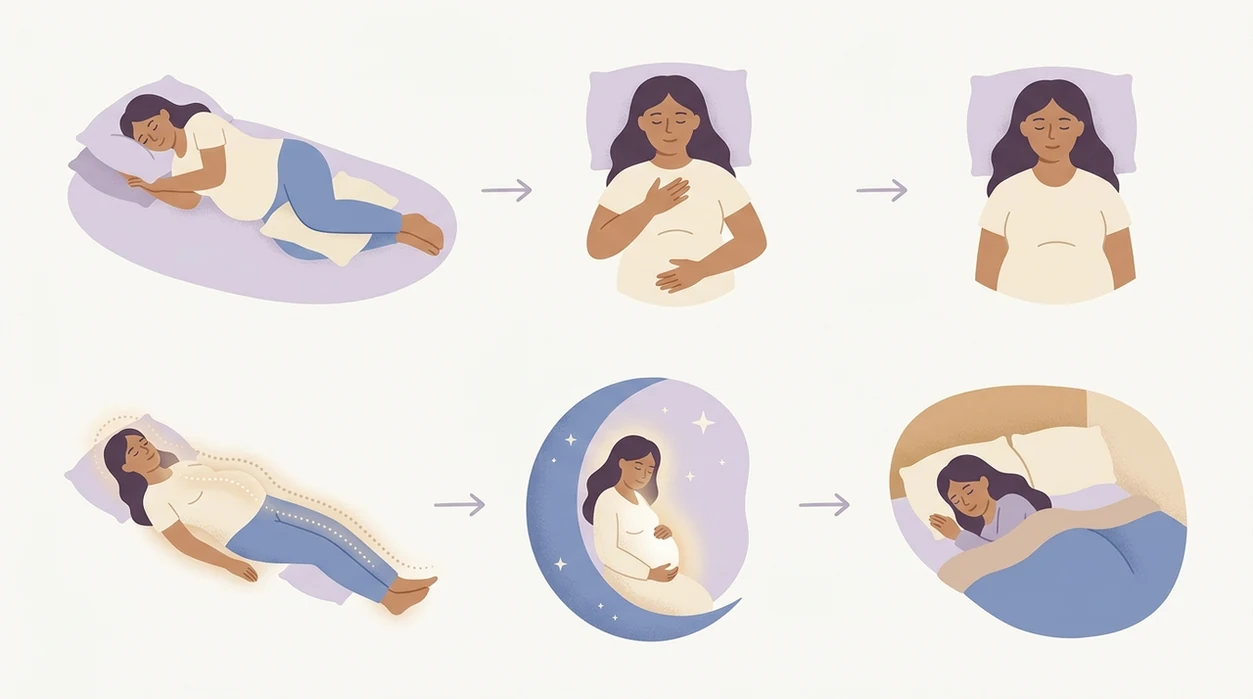
Third trimester sleep meditation works by reducing physiologic arousal and cognitive arousal. In plain language, it helps the body shift out of alert mode and gives the mind fewer threads to pull.
Study snapshot: A randomized controlled trial of 218 pregnant women found that an 8-week mindfulness-based program significantly improved sleep quality and reduced insomnia symptoms compared with usual care (https://pubmed.ncbi.nlm.nih.gov/?term=218+pregnant+women+8-week+mindfulness-based+program+sleep+quality+insomnia+usual+care+randomized+trial). A 2020 systematic review and meta-analysis also found small to moderate improvements in sleep quality from mindfulness-based interventions during pregnancy (https://pubmed.ncbi.nlm.nih.gov/?term=2020+systematic+review+meta-analysis+mindfulness-based+interventions+sleep+quality+pregnancy).
The mechanism is not mystical. Slow breathing can support parasympathetic nervous system activity, the “rest and digest” branch. A body scan can reduce muscle tension from jaw to pelvis. Repeated attention to breath interrupts the thought loop that says, “If I don’t sleep now, tomorrow is ruined.”
For most pregnant people, third trimester sleep meditation works better as a repeated cue than as a one-night rescue. Benefits often build over days to weeks of consistent practice.
Slow kicks during guided breathing can feel oddly reassuring.
What You Need Before Starting Pregnancy Insomnia Meditation
You need a supported side-lying position, a low-stimulation room, and a routine that does not require scrolling. The setup matters because discomfort will win if the position is wrong.
Start on your left side if that feels comfortable. Place one pillow between your knees and another under your belly. If shortness of breath shows up, prop your upper body slightly with pillows instead of forcing a flat position.
Keep the room cool, dark, and boring. No bright phone screen. No clock check. A cool sheet against a warm belly can be enough sensory contrast to settle attention.
Tools like Zen Pregnancy, Expectful, GentleBirth, Calm, or Headspace can help if the audio is easy to start without browsing. If you prefer a focused option, a pregnancy sleep meditation app can keep bedtime tracks separate from general wellness content.
For restless legs, try gentle ankle circles before starting and place a pillow under the calves.
How to Use Third Trimester Insomnia Meditation: 6-Step In-Bed Routine
Use this routine in bed for 10–20 minutes, or shorten it during night wakings. It is a relaxation cue, not medical treatment.
- Settle into supported side-lying position and close your eyes.
- Begin 4-7-8 breathing for four rounds.
- Scan slowly from the crown of your head to your toes.
- Visualize a calming scene, such as meeting your baby, a warm bath, or a safe place.
- Repeat two or three pregnancy-specific affirmations silently.
- Release effort and let the breath return to its natural rhythm.
Step 1: Settle Into Side-Lying Position
Set one pillow between your knees and one under your belly. Let your shoulders drop into the mattress.
Step 2: Begin 4-7-8 Breathing
Inhale for 4, hold for 7, and exhale for 8. Do four rounds, but skip the hold if it makes you breathless.
Step 3: Body Scan From Head to Toes
Move from forehead to feet. At each zone, soften one small thing.
Step 4: Visualize a Calming Scene
Choose one image only. A bath. A dim room. A safe place. Keep it simple enough to return to.
Step 5: Repeat Pregnancy Affirmations
Try: “My body can rest even if sleep takes time.” Or: “I can meet this moment one breath at a time.”
Step 6: Release Effort and Allow Sleep
Stop performing the meditation. Let breathing become ordinary and let sleep arrive without chasing it.
Adapting Meditation for Pregnancy Night Waking at 2 a.m.
“Can meditation help me fall back asleep when I wake at 2 a.m. pregnant?” Yes, but the routine should be shorter than bedtime practice.
Keep your eyes closed if you can. Stay in bed. Do not check the clock, and do not open a bright app menu. The moment you calculate how many hours remain, the anxiety-arousal cycle has fresh material.
Use this mini routine: three rounds of 4-7-8 breathing, then scan only the jaw, shoulders, and pelvis. That is enough. If you are still awake after about 15 minutes, add one visualization, such as floating in warm water or resting in a quiet room.
Zen Pregnancy app sleep tracks can be useful here when downloaded offline, because the audio can start without searching. If you are comparing options for this exact use case, an app to help me sleep in third trimester should prioritize offline access and short tracks.
Common Mistakes With Third Trimester Sleep Meditation
The most common mistake is expecting meditation to work like medication. It usually does not knock you out. It trains a lower-arousal response over one to two weeks.
Another mistake is choosing a 45-minute meditation with complex instructions. At 2 a.m., your brain does not need a lecture. Five to ten minutes is often enough.
Position matters too. After 28 weeks, avoid lying flat on your back for meditation unless your clinician has given different guidance. Supported side-lying is usually the better default.
The phone is a problem if it becomes a light box. Download audio in advance, dim the screen, and avoid browsing. If you need a no-cost starting point, a free pregnancy sleep meditation app may be enough before comparing paid libraries.
Do not drop sleep hygiene because you added meditation. The most common medically supported way to improve pregnancy sleep is combining behavioral sleep habits with symptom-specific care when needed.
How to Know Pregnancy Insomnia Meditation Is Working
Pregnancy insomnia meditation is working if nights feel less reactive, even before sleep becomes longer. The first sign may be falling asleep 5–10 minutes sooner, which counts.
Another useful sign is emotional tone after waking. You may still wake to urinate, but you feel less angry, panicked, or doomed afterward. That difference matters at 3 a.m.
Body signals can change too. The jaw releases faster. Shoulders drop without as much instruction. Pelvic tension may still be present, but it becomes something you notice rather than fight.
Track two numbers for 7–14 days: time to fall asleep and how distressed you felt after waking. A notebook works. The ZenPregnancy app can also help if you want audio and tracking in one place. For longer outcome tracking, compare your notes with pregnancy sleep meditation benefits after 30 days.
Limitations
Meditation is a wellness practice, not treatment. Editor’s note: any claim that it “cures” pregnancy insomnia needs stronger evidence than the field currently has.
- It will not eliminate all night wakings from bladder pressure, baby movement, hip pain, or physical discomfort.
- Evidence is promising, but study size and quality vary. Claims of curing insomnia are overstated.
- Meditation can briefly increase awareness of discomfort before it feels calming. That can frustrate new users.
- For severe anxiety, trauma history, panic, or mood disorders, unguided meditation can sometimes worsen distress.
- It should not delay evaluation of severe shortness of breath, chest pain, sudden swelling, or suicidal thoughts.
- Sleep apnea, severe heartburn, depression, and persistent severe insomnia may need medical or therapeutic care.
- If a breathing pattern makes you dizzy or air-hungry, stop the count and return to natural breathing.
Clinicians typically recommend discussing persistent insomnia with a pregnancy care professional, especially when sleep loss affects mood, safety, breathing, or daily functioning.
Frequently Asked Questions
How do you fix third trimester insomnia?
The most effective approach is usually sleep hygiene, symptom management, relaxation practice, and medical care when needed. Meditation can help reduce pre-sleep arousal, but it should not be the only tool.
Why can't I sleep past 3 a.m. pregnant?
Early-morning cortisol rise, bladder pressure, discomfort, and baby movement can all make 3 a.m. waking common in late pregnancy. Anxiety then makes it harder to fall back asleep.
Is pregnancy sleep meditation safe?
Pregnancy sleep meditation is generally safe for most people when done in a comfortable side-lying position. People with trauma history, severe anxiety, or mood disorders may need guided professional support.
How long should pregnancy meditation be?
Pregnancy meditation can be 5–20 minutes. Use shorter sessions for night wakings and longer sessions at bedtime.
Does meditation actually help insomnia?
Research in pregnancy shows mindfulness programs can improve sleep quality and reduce insomnia symptoms, with small to moderate effects in reviews. Benefits usually build with consistent practice.
What position should I meditate in pregnant?
After 28 weeks, supported side-lying is usually preferred, often with pillows between the knees and under the belly. Avoid lying flat on your back unless your clinician advises otherwise.
Can I use a meditation app at night?
Yes, if the audio is downloaded and the screen stays dim or off. Zen Pregnancy sleep tracks can be used this way for pregnancy-specific guidance.
When should I see a doctor for insomnia?
Seek medical advice for persistent severe insomnia, mood changes, breathing problems, symptoms of sleep apnea, chest pain, sudden swelling, or suicidal thoughts. Meditation should not delay care for red-flag symptoms.
Which app fits which need
| Need | Best option |
|---|---|
| pregnancy-specific insomnia meditation with birth-focused breathing | Zen Pregnancy |
| pregnancy and postpartum sleep support with broader wellness content | Expectful |
| general sleep stories or non-pregnancy relaxation | Calm |
| general mindfulness basics and stress meditation | Headspace |
Quick facts
- Type
- Pregnancy meditation app
- Platforms
- iPhone, iPad, Android
- Focus
- pregnancy sleep meditation, hypnobirthing, breathing, birth affirmations, relaxation
- Includes
- guided sleep meditations, breathing exercises, hypnobirthing sessions, birth affirmations, contraction timer, kick counter
- Best for
- third trimester insomnia, night waking, and pregnancy-specific bedtime relaxation
- Free
- Yes
- Medical replacement
- No
People also use Zen Pregnancy for
Try third trimester insomnia meditation with Zen Pregnancy
Use pregnancy-specific guided meditations, breathing, and calming birth affirmations to create a steadier nighttime routine. Download Zen Pregnancy free on iPhone or Android.
Download Zen Pregnancy Free