
Yoga ball pregnancy exercises: 8 moves to try
Learn how to choose a stable ball, practice eight gentle movements, and use round and peanut balls during labor.


200,000+ parents • Rated 4.8 from 12,000+ ratings • Free, with optional premium
Quick answer. Yoga ball pregnancy exercises can be a comfortable way to add gentle movement during an uncomplicated pregnancy, provided your clinician agrees and you can stay stable. Choose a properly inflated, burst-resistant ball that lets you sit with both feet flat and your hips level with or slightly above your knees. A ball can also support upright and forward-leaning positions during labor, but it is not proven to start labor or prevent a C-section.
How we wrote this. We are not doctors. This guide is based on published recommendations from ACOG, checked in November 2026. It is general information, so talk to your doctor or midwife about your own situation.
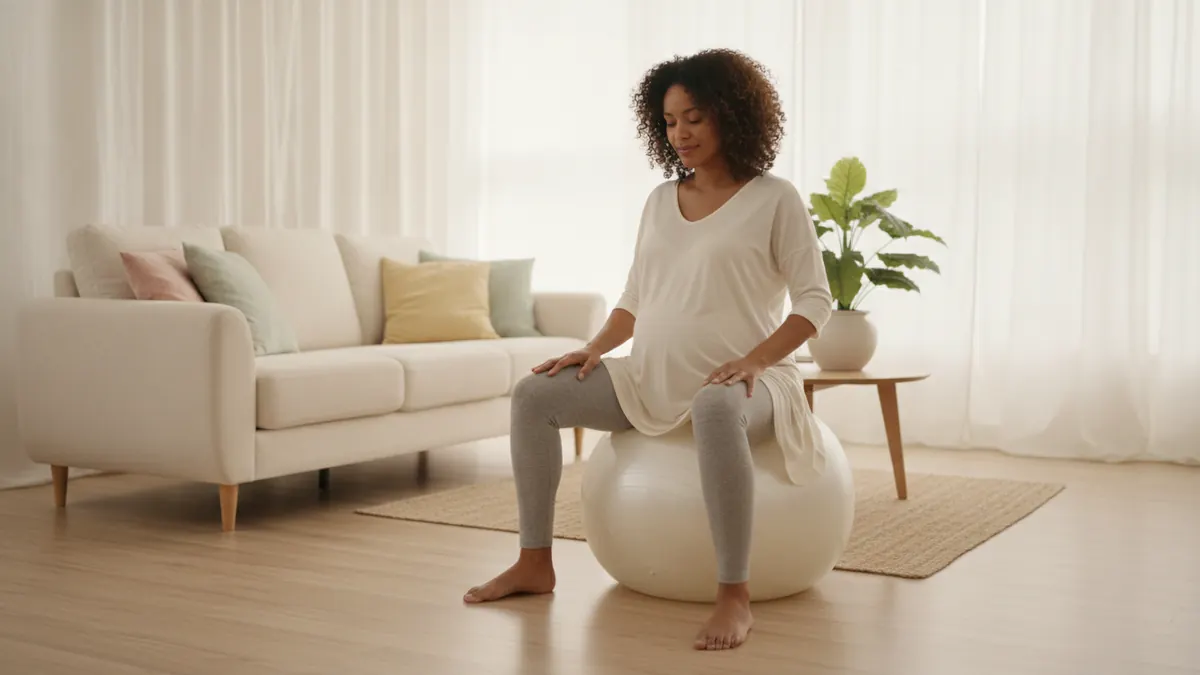
Are yoga ball pregnancy exercises safe?
For most people with an uncomplicated pregnancy, gentle exercise on a stable ball can be reasonable after clinical evaluation. ACOG says regular physical activity is generally safe and does not increase the risk of miscarriage, low birth weight, or early delivery in an otherwise healthy pregnancy.
ACOG recommends at least 150 minutes of moderate aerobic activity each week, spread across the week, and lists modified yoga as an appropriate activity. It does not prescribe these specific ball exercises. Think of them as practical movement options rather than a medical routine. Our prenatal yoga guide and pregnancy stretches cover more ways to move without forcing your range.
Speak with your OB-GYN or midwife before starting a new routine. You will need individual advice if you have placenta previa after 26 weeks, cervical insufficiency, preeclampsia, significant heart or lung disease, a risk of preterm labor, or another pregnancy complication.
Stop exercising and call your OB-GYN, midwife, or labor and delivery unit for chest pain, headache, vaginal bleeding, leaking fluid, regular painful contractions, dizziness, trouble breathing before exercise, calf pain or swelling, severe pain, or reduced fetal movement once you normally feel movement.
What size yoga ball is best for pregnancy?
The best size lets you sit securely with both feet flat and your hips level with or slightly higher than your knees. If your knees rise well above your hips, or your feet cannot stay planted, try another size or adjust the inflation according to the manufacturer's instructions. For slow breathing while you sit on the ball, put on a Zen Pregnancy guided track, from the App Store breathing audio or the Google Play breathing audio, and keep the pace slow.
ACOG does not publish an official height-based ball size chart. The measurements below are common retail recommendations, so check the chart for the exact exercise ball for pregnancy that you plan to buy.
| Your height | Common retail starting size | What to check |
|---|---|---|
| Under 5 ft 4 in | 45 cm | Both feet flat, with knees no higher than the hips |
| 5 ft 4 in to 5 ft 10 in | 55 cm | Hips level with or slightly above the knees |
| Over 5 ft 10 in | 65 cm | Stable sitting without reaching for the floor |
Your seated position matters more than the number printed on the box. Body proportions vary, and two people of the same height may prefer different balls.
How should you set up an exercise ball for pregnancy?
Use a properly inflated, burst-resistant fitness or birth ball on a nonslip surface. For seated exercises, put the ball near a wall or sturdy chair until you know how it moves under you.
- Keep both feet firmly on the floor and set them wide enough to feel stable.
- Use footwear or socks that grip the floor.
- Keep a wall, countertop, chair, or partner within easy reach.
- Make each movement small enough that you remain in control.
- Avoid exercises with a high risk of falling or being hit in the abdomen.
- Do not use the ball during hot yoga or hot Pilates. ACOG advises avoiding these because of the risk of overheating.
There is no prize for making a circle bigger or a squat deeper. Pregnancy changes balance, and the right range is the one you can control without pain, straining, or holding your breath.
Which eight birth ball exercises can you try?
These eight birth ball exercises use slow, controlled movement. You do not need to perform them as a circuit. Pick the ones that feel secure and comfortable that day.
1. Supported sitting
- Place the ball on a nonslip surface near a wall or sturdy chair.
- Sit with your feet flat and wider than hip width.
- Keep your spine comfortably long and rest your hands on the ball or a stable support.
- Breathe normally for one to five minutes, or for a shorter period if that feels better.
2. Pelvic tilts
- Sit upright with your feet flat and wide enough for balance.
- Gently tuck your pelvis under.
- Return to a neutral sitting position without forcing your lower back.
- Repeat 8 to 12 slow times.
3. Pelvic circles
- Sit securely with your feet wide and your hands supported if needed.
- Move your hips in a small, slow circle.
- Complete a few comfortable circles, then reverse direction.
- Reduce the circle size if the ball starts to feel unstable.
4. Side-to-side rocking
- Sit with a wall, stable chair, or partner nearby.
- Shift your weight gently toward one sitting bone.
- Move back through the center and shift to the other side.
- Keep both feet grounded as you continue for several comfortable breaths.
5. Forward lean
- Kneel on a padded surface with the ball in front of you.
- Lean your chest and forearms onto the ball while leaving room for your abdomen.
- Breathe normally and keep the movement controlled.
- Push through your hands and thighs to return upright.
6. Supported squat
- Place the ball between your lower back and a wall, or hold a stable support.
- Step your feet slightly forward.
- Lower only as far as feels comfortable, keeping your knees pointed in the same direction as your toes.
- Press through your feet to stand.
7. Standing hip sways
- Stand facing a wall or countertop and hold the ball securely against it.
- Plant your feet in a stable position.
- Sway your hips gently from side to side without leaning onto an unstable surface.
- Make the movement smaller if your balance changes.
8. Upper-body mobility
- Sit or stand in a secure position and hold the ball with both hands.
- Make a small arm lift or move the ball gently forward and back.
- Keep your shoulders relaxed and continue breathing.
- Lower the ball if lifting it changes your balance or makes you strain.
How can you use a birth ball during labor?
A round birth ball can support upright sitting, gentle rocking, forward leaning, and supported squatting during labor. ACOG includes birthing balls among labor comfort tools, although it does not promise shorter labor or a particular birth outcome.
Ask your hospital or birth center whether it provides balls and when you can use one. Monitoring, induction equipment, ruptured membranes, medication, and fall risk may affect what is practical. Add your preference to your birth plan, while leaving room for the clinical situation on the day.
- Use the ball on a stable, nonslip surface.
- Ask a partner or staff member to brace the ball rather than pulling you up by the arms.
- Try sitting and rocking, leaning over the ball from a kneeling position, or using it during a supported squat.
- Combine movement with comfortable birthing positions and breathing exercises for active labor.
A birth ball may make a position more comfortable. It is not proven to trigger labor, shorten labor, or guarantee a vaginal birth.
Can you use a peanut ball with an epidural?
A peanut ball may be used with an epidural when maternity staff approve and assist with positioning. Unlike a round ball, a peanut ball has an elongated shape and usually sits between the legs while the laboring person lies on their side.
This can offer another way to position the legs when an epidural limits standing or walking. Staff need to help because sensation and leg strength may be reduced. They also need access to fetal monitoring, the epidural setup, and pressure points. Read about the wider benefits and tradeoffs of an epidural before labor if you are considering one.
The evidence is less persuasive than social media sometimes makes it sound. ACOG reviewed four randomized trials involving 648 people having their first baby. The review found no significant difference in labor duration, vaginal birth, or cesarean birth. ACOG says more data are needed and does not recommend routine peanut ball use.
What can a pregnancy ball actually do?
A pregnancy ball can provide a stable surface for supported movement and may be used as comfort equipment in labor. Claims that it starts labor, turns a breech baby, prevents a C-section, or guarantees an easier birth are unproven in the cited ACOG guidance.
| Common claim | What the guidance says |
|---|---|
| Bouncing starts labor | Not established |
| Ball exercises turn a breech baby | Not confirmed |
| A peanut ball prevents a C-section | Trials found no significant overall difference in cesarean birth |
| A larger ball is always safer | No. Stable fit and foot position matter more |
If you are near your due date, read our guide to exercises to induce labor before treating any movement as an induction method. A ball is useful equipment, but it is not a switch that starts labor. For guided sessions, try prenatal yoga online with birth ball work.
Frequently asked questions
What size yoga ball should I use during pregnancy?
Choose a size that lets you sit with both feet flat and your hips level with or slightly above your knees. Common retail charts suggest 45 cm under 5 ft 4 in, 55 cm from 5 ft 4 in to 5 ft 10 in, and 65 cm over 5 ft 10 in. These are manufacturer starting points, not an official ACOG chart.
Is bouncing on a pregnancy ball safe?
Gentle movement may be reasonable in an uncomplicated pregnancy after your clinician agrees. ACOG does not specifically endorse bouncing, so avoid vigorous movement and anything that makes the ball or your balance feel unstable.
How long should I sit on a pregnancy ball?
ACOG does not give a set time limit. Begin with a short, comfortable period, change position regularly, and get off the ball if you feel uncomfortable or unstable.
Can a yoga ball start labor?
There is no established evidence in the cited ACOG guidance that bouncing, rocking, or circling on a ball starts labor. You can use it for movement or comfort without treating it as a reliable induction method.
Can a birth ball turn a breech baby?
The cited guidance does not confirm that birth ball exercises can turn a breech baby. Discuss fetal position and appropriate options with your OB-GYN or midwife.
Is a peanut ball better than a round birth ball?
They have different uses. A round ball supports upright movement, leaning, and squatting, while a peanut ball usually supports side-lying positions during labor. ACOG does not say that either one is better for everyone.
Does a peanut ball help with an epidural?
A peanut ball can support side-lying positions when an epidural limits mobility, but staff must help with placement and repositioning. ACOG found no significant overall improvement in labor duration, vaginal birth, or cesarean birth and does not recommend routine use.
Sources
- ACOG: Exercise During Pregnancy
- ACOG: Thinking About Childbirth Without Pain Medication
- ACOG: First and Second Stage Labor Management
Written by the Zen Pregnancy team for general information. It does not replace advice from your own doctor or midwife.