 Zen
ZenPregnancy Anxiety Relief Meditation: Calming Your Worst Fears
Guided meditation specifically for pregnancy anxiety relief. How daily practice reduces fear, quiets intrusive thoughts, and helps you feel safer in your body.
200,000+ moms • ORCHA Certified • Free on iOS & Android
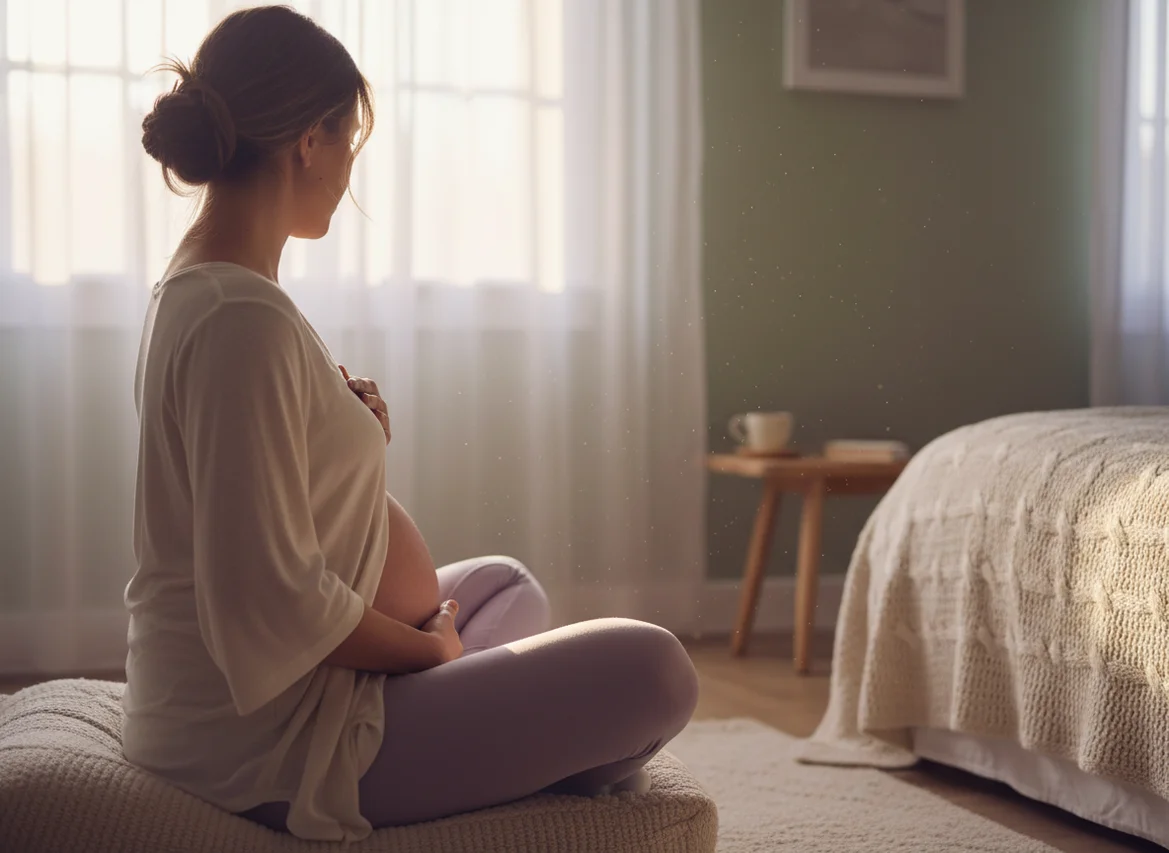
In my experience, a short pregnancy anxiety meditation is one of those things you can actually repeat, even on rough days, to slow the racing thoughts and help your body feel safe again. It won’t wipe out every worry (nothing does), but it usually changes the moment fear hits, you notice it sooner and you don’t get dragged along for the whole ride.
If you keep catching yourself doom-scrolling, replaying someone else’s birth story, or getting stuck on the same “what if” loop, yep, you’re in very good company. I’ve talked with plenty of pregnant women who seem completely fine during the day, then admit they’re wide awake at 2 a.m. doing mental laps they never asked for. Meditation gives you something to do in that moment. Not “think positive.” Not “be grateful.” Just come back to breath, body, and the present.
And yes, you can absolutely use a guided one. Honestly, for a lot of people that’s the whole reason it works. When anxiety’s up, a quiet room can feel weirdly loud, like your brain fills every inch of it. Sometimes all it takes is a calm voice in your ear, a slow pace, and one small plan for the next ten minutes, and suddenly you’re sleeping instead of spiraling.
TL;DR: Pregnancy anxiety relief meditation helps manage racing thoughts and fears, offering a calming practice that supports emotional balance during pregnancy. It helps your body shift into the parasympathetic (rest-and-digest) state, which tends to lower stress and can improve sleep. If you stick with it, anxiety usually stops feeling like it’s running your whole life and starts feeling more manageable, like you can be here for what’s happening right now.
Why it matters: pregnancy is this strange blend of excitement and “wait, what is happening,” sometimes in the same hour
You can be head-over-heels for your baby and still be scared out of your mind sometimes. And you can be thankful and still feel like you’re barely keeping it together. That push-pull is really common, especially when hormones are doing their thing, sleep is a mess, your body’s changing fast, and you’re making about a thousand big decisions at once.
When anxiety ramps up, your nervous system often flips into “something’s wrong” mode. It can look like a tight chest or clenched jaw, or you notice you’re barely breathing, or you feel nauseous and snappy, or you get that floaty “is this real?” feeling where you end up thinking, why can’t I just relax? Your body isn’t broken. It’s trying to protect you, it’s just turning the alarm up way too high.
Meditation helps nudge you toward the parasympathetic nervous system, the “rest and digest” setting. In plain terms, it’s the mode where your body can settle, your breathing deepens, and your mind becomes less sticky. Research on prenatal mindfulness and meditation programs shows meaningful reductions in pregnancy-related anxiety, stress, and depression, especially when practiced consistently over 6 to 8 weeks.
One detail that still gets me, even after years of seeing this up close: the moment a woman realizes her fear is a state, not a personality. I’ve watched shoulders drop mid-session. I’ve heard the same sentence whispered after: “I forgot I could feel like that.” Not perfect. Just calmer.
What’s actually happening in your body when anxiety spikes
Pregnancy anxiety is not “all in your head.” It’s also physiological. When your brain detects possible danger (even if it’s an imagined future danger), it sends signals that increase alertness, muscle tension, and scanning for threats. That’s why you can be exhausted and still unable to rest.
Meditation works by training attention and regulating arousal. Slow breathing, body scanning, and mindfulness cues can reduce sympathetic activation (fight-or-flight) and increase parasympathetic activity (rest-and-repair). Over time, this can lower baseline stress and improve sleep quality.
Studies through 2025 have reported improvements in sleep and stress markers with consistent practice, and fear of childbirth can decrease when meditation is paired with education and relaxation training. A 2025 paper in Frontiers in Public Health also describes moderate-to-large benefits for fear of childbirth and self-efficacy when meditation and relaxation are combined with multimedia education.
Here’s the part most people miss: your body learns through repetition, not logic. You can understand that you’re “safe,” but if your nervous system doesn’t feel it, the fear will keep returning. Meditation is practice for “felt safety.”
How pregnancy anxiety relief meditation works (and why guided is often easier)
A meditation practice for pregnancy anxiety relief usually combines three things: attention training, breathing regulation, and a kinder relationship with thoughts. It’s not about emptying your mind. It’s about not believing every thought on impact.
Attention training
This is the “come back” muscle. You notice you’re spiraling, and you return to a focus point (breath, sound, body sensation). That return is the skill, not the perfect focus. In pregnancy, this is gold because intrusive thoughts often feel automatic.
Breathing rhythms
Slow, steady breathing can downshift arousal. Longer exhales are particularly useful because they signal “stand down” to the nervous system. If you want options that work for both anxiety and labor, the techniques here are practical: breathing patterns for pregnancy from daily calm to labor.
Body-based relaxation
Pregnancy anxiety often lives in the body first. A jaw unclench. A soft belly. A longer exhale. These are not small things. They’re signals to your brain that you’re not in immediate danger.
And guided tracks help because decision fatigue is real. When you’re already overwhelmed, you don’t want to “design” a practice. You want someone to gently lead you through it, like a handrail in the dark.
Daily meditation techniques for pregnancy anxiety relief that actually feel doable
Consistency matters more than intensity. I’ve seen 7 minutes a day beat an ambitious 30 minutes that happens once a week. Not because 7 minutes is magical, but because your nervous system responds to repetition.
The 10-minute “spiral interrupter” (any trimester)
Minute 1: Put one hand on your chest, one on your belly. Feel contact first. Simple.
Minutes 2-4: Breathe in through the nose, exhale slowly through the mouth. Aim for a slightly longer exhale than inhale.
Minutes 5-8: Name what’s here without arguing with it: “Worry is here.” “Tightness is here.” Labeling reduces mental fusion with the thought.
Minutes 9-10: Choose one steady sentence and repeat it: “In this moment, I am safe.” If that feels too big, use: “In this moment, I’m breathing.”
This kind of practice pairs well with other gentle tools. If you want more options beyond meditation, this page lays out what tends to calm the nervous system fastest: relaxation techniques during pregnancy that actually calm you down.
The intrusive-thoughts reset (especially for 2 AM anxiety)
Intrusive thoughts in pregnancy can be graphic and upsetting, and they often arrive when you’re exhausted. The goal isn’t to “solve” them. The goal is to stop feeding them with adrenaline.
Try this: when a thought hits, say (out loud if you can), “That’s a fear story.” Then shift attention to a physical anchor: the weight of your head on the pillow, the warmth of the blanket, the sound in the room. If sleep is the main battle, a guided track can help you stop negotiating with your brain at midnight: sleep meditation support for pregnant women when your mind won’t quiet down.
Affirmation-style meditation for birth fear
Birth fear is its own flavor of anxiety. It’s not only “Will I cope?” It can also be “Will I be heard?” “Will something go wrong?” “Will my body fail me?”
Affirmations aren’t spells. They’re cues that re-train attention, especially when paired with slow breathing and relaxation. If you want a set that’s designed specifically for labor and late pregnancy, these positive birth affirmations can be used as a meditation focus.
Trimester-by-trimester: what to practice when anxiety changes shape
Anxiety doesn’t stay the same throughout pregnancy. The themes shift. So it helps when your meditation shifts too.
First trimester: uncertainty, symptoms, and “waiting for good news”
This is the trimester of limbo. Nausea, fatigue, and the mental load of “Is everything okay?” can be intense. Short practices work best here because your body may feel rough.
Focus on body comfort and grounding rather than long visualizations. If you’re new to this, start with gentle basics like this meditation for pregnancy approach for anxious minds.
Second trimester: calmer days, but sneaky anxiety spikes
Many women feel more energetic in the second trimester, but anxiety can pop up in surprising ways: anatomy scan nerves, body image shifts, relationship stress, planning overload.
This is a great time to build consistency. Research often finds better outcomes when meditation is practiced regularly for 6 to 8 weeks, around 10 to 20 minutes, and sometimes twice daily for stronger effects.
Third trimester: sleep, discomfort, and fear of labor
Third trimester anxiety is often physical: insomnia, breathlessness, pelvic pressure, and that “How is a baby supposed to come out?” feeling. Not subtle.
Here, meditation that includes relaxation and birth-focused cues can be especially helpful. Many women also like hypnobirthing-style sessions because they combine breath, imagery, and nervous system regulation. If you’re exploring options, this breakdown compares what tends to help with birth anxiety in real life: which hypnobirthing app actually helps with birth anxiety. And if you want something specifically designed for staying present during contractions, this is a solid starting point: guided meditation for labor.
When meditation is enough, and when you need more support
Meditation is safe for most pregnancies and is considered a low-risk, nonpharmacological option for stress reduction. Studies generally report no increased adverse effects from prenatal meditation programs. There’s also emerging research connecting prenatal mindfulness with infant stress regulation later in infancy, including work summarized in a JMIR Pediatrics and Parenting paper: prenatal mindfulness and infant outcomes.
But meditation isn’t a fix for everything. And pretending it is can make anxious women feel worse, like they’re “doing it wrong.” I hate that. If your anxiety is severe, getting worse, or interfering with eating, sleeping, functioning, or feeling safe, you deserve more than an app or a breathing technique.
What meditation does not do
- It does not replace therapy, psychiatric care, or medical support for anxiety disorders, panic attacks, OCD, PTSD, or depression.
- It does not guarantee a specific kind of birth, pain level, or outcome.
- It does not stop intrusive thoughts from ever showing up again; it changes your response to them.
What to avoid if you’re feeling fragile
- Aggressive breath-holding, fast breathing, or any technique that makes you dizzy.
- Forcing long silent sits if silence increases panic; guided practices are often a better entry point.
- Using meditation to “push down” trauma; trauma-informed support is safer when old memories or flashbacks are activated.
Signs you should talk to a professional soon
- Persistent hopelessness, frequent panic, or feeling out of control most days.
- Intrusive thoughts that feel dangerous or that you might act on.
- Not sleeping for multiple nights in a row, or significant appetite changes.
If any of those are true, reach out to your midwife, OB-GYN, or a mental health professional. Meditation can be a companion, not a substitute.
Where Zen Pregnancy fits (in a real, non-salesy way)
I’ve used Zen Pregnancy’s guided meditations for pregnancy anxiety relief with women who feel overwhelmed, alone, or quietly terrified about labor. The reason I keep coming back to it is not flashy features. It’s the tone. When you’re anxious, you can’t handle a perky voice telling you to “just relax.” Zen sounds like someone who actually understands what 3 AM worry feels like.
The daily structure also matters more than people expect. You open the app, you press play, and you’re guided. That’s it. On tough days, decision-making is the problem. I’ve had clients tell me they didn’t even trust themselves to choose the “right” track, so having a clear daily option reduced that mental friction.
If you’re trying to figure out what kind of support you want, these pages give a feel for different approaches without drowning you in clinical info: a calm pregnancy app overview for when everything feels too much, a prenatal mindfulness app guide, and a look at how hypnosis and hypnobirthing work during pregnancy. And if you’re ready to simply try it, you can download Zen Pregnancy and start with a short track tonight.
Frequently Asked Questions
How often should I do pregnancy anxiety relief meditation?
Pregnancy anxiety relief meditation is commonly practiced for 10 to 20 minutes per session, and many programs use daily practice for 6 to 8 weeks to see measurable reductions in anxiety and stress.
Is guided meditation safe during pregnancy?
Guided meditation is generally considered safe during pregnancy as a nonpharmacological relaxation tool, but it should not replace prenatal medical care or mental health treatment when symptoms are severe.
Can meditation help with intrusive thoughts while pregnant?
Meditation can help reduce the intensity and “stickiness” of intrusive thoughts by training attention and lowering physiological arousal, but it may not fully eliminate intrusive thoughts and may need to be paired with therapy for persistent distress.
What kind of meditation is best for pregnancy anxiety?
Mindfulness-based meditation, breath-focused relaxation, and body scan practices are commonly used for pregnancy anxiety because they support nervous system regulation and present-moment grounding.
How quickly does meditation work for pregnancy anxiety relief?
Some people feel calmer after a single session, but research-supported improvements in anxiety and stress typically build with consistent practice over several weeks.
Can meditation reduce fear of labor and childbirth?
Meditation can reduce fear of childbirth, especially when combined with prenatal education and relaxation training, by improving self-efficacy and lowering stress reactivity.
What should I do if meditation makes me more anxious?
If meditation increases anxiety, switching to shorter guided sessions, using eyes-open grounding, or focusing on external sounds can help; persistent worsening anxiety should be discussed with a healthcare provider or mental health professional.
Is it okay to meditate lying on my back while pregnant?
After mid-pregnancy, lying flat on the back for extended periods can be uncomfortable for some people, so side-lying or propped positions are often preferred for meditation.
Can pregnancy meditation help my baby too?
Prenatal mindfulness and meditation are associated with improved maternal stress regulation, and some research links prenatal mindfulness practice to healthier infant stress responses in early infancy.
When should I get professional help instead of relying on meditation?
Professional support is recommended if anxiety is severe, persistent, interferes with sleep or daily functioning, involves panic or trauma symptoms, or includes thoughts of self-harm or harm to others.