
Your trimester-by-trimester pregnancy checklist
A practical pregnancy to do list for appointments, paperwork, birth preparation, and the small jobs that are easy to forget.


200,000+ parents • Rated 4.8 from 12,000+ ratings • Free, with optional premium
Quick answer. A pregnancy checklist should track prenatal appointments, tests your clinician offers, vaccination dates, paperwork, classes, birth preferences, baby supplies, and your hospital bag. Organize it by trimester, but get the exact medical schedule from your OB-GYN or midwife because your health history and pregnancy may change what you need.
How we wrote this. We are not doctors. This guide is based on published recommendations from ACOG, checked in November 2026. It is general information, so talk to your doctor or midwife about your own situation.
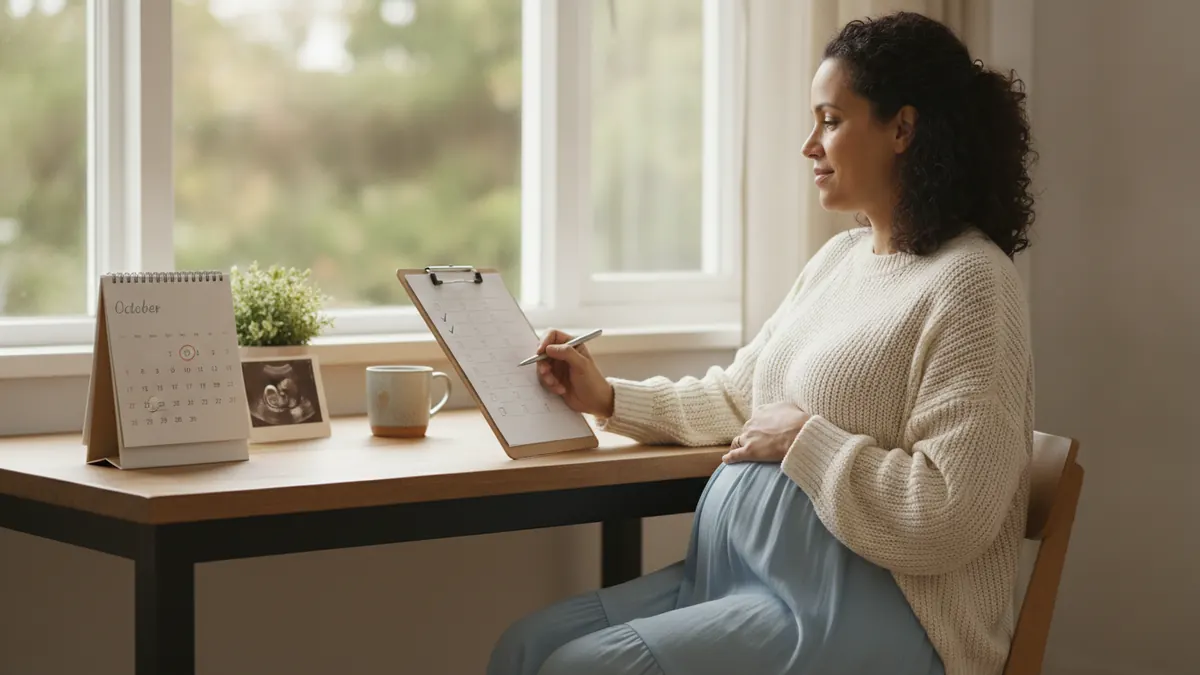
How should you use this pregnancy checklist?
Use this pregnancy checklist as a working list, not a rigid medical calendar. Put every appointment and deadline into your phone, then keep one short list of questions for your OB-GYN or midwife. That is much easier than trying to remember everything in the exam room.
For each appointment or test, record the date, what it is for, whether you need to prepare, when results should arrive, and who will contact you. Your clinician should give you the exact schedule for prenatal visits, laboratory work, screening, and ultrasounds. A pregnancy journal is a good place to keep those notes and questions.
| When | Main jobs |
|---|---|
| After pregnancy is confirmed | Arrange prenatal care, gather health records, review medicines and vaccines |
| First trimester | Build your care calendar, discuss tests, check insurance and leave |
| Second trimester | Continue care, book classes, start birth and baby planning |
| Third trimester | Review vaccines, finish your birth plan, pack your bag, confirm transport and support |
What should you do after a positive pregnancy test?
Arrange your first prenatal encounter and start gathering the information your care team will need. A positive home test does not replace prenatal care.
- Contact an OB-GYN, midwife, or prenatal clinic and ask how to arrange your first visit.
- Write down your medical history, previous pregnancies, operations, allergies, and emergency contacts.
- Make a complete list of prescription medicines, over-the-counter products, and herbal products. Ask your clinician to review them before you make changes.
- Find your vaccination record. ACOG recommends discussing pregnancy vaccines at the first prenatal encounter.
- Check which clinicians and birth facilities your insurance covers.
- Start a folder for visit notes, test results, insurance forms, receipts, and leave paperwork.
If uncertainty is making it hard to sleep or get through the day, keep the list small. One phone call and one form is still progress. Our guide to first trimester anxiety has practical ways to slow the mental spiral.
What belongs on a first trimester checklist?
Your first trimester checklist should establish prenatal care, clarify which tests apply to you, and deal with paperwork that may take time.
- Attend your first prenatal encounter and bring your health, medicine, allergy, and vaccination information.
- Ask which blood tests, infectious-disease tests, genetic screening options, and ultrasounds your clinician offers. Write down what each test checks and when you need to decide.
- Ask how and when the clinic shares results.
- Discuss influenza and COVID-19 vaccination. ACOG's maternal immunization schedule permits both at any gestational age.
- Confirm your preferred pharmacy and the clinic's after-hours contact details.
- Review health insurance, disability coverage, parental leave, and any forms your employer requires.
- Make a simple budget for medical bills, time away from work, baby equipment, and childcare.
Do not let an app become the only place holding sensitive health details. If you use one, review its privacy practices and read our guide to pregnancy app privacy.
What should you handle in the second trimester?
The second trimester is a good time to keep up with care while making decisions that are harder to tackle near the end of pregnancy.
- Attend prenatal visits and complete the tests or ultrasounds your clinician recommends.
- Ask for results you have not received and note whether any follow-up is needed.
- Choose your planned hospital or birth center and learn its registration process.
- Compare childbirth, infant-care, breastfeeding, and infant CPR classes.
- Talk with your birth partner or support person about work schedules, transportation, and care for other children or pets.
- Start a baby equipment list. Prioritize an infant car seat, a place for the baby to sleep, clothing, and feeding supplies rather than buying every gadget.
- Begin writing birth preferences while there is time to ask questions.
If you want structured preparation, compare online birthing classes and breastfeeding courses. Check who teaches the course, what it covers, and whether you can revisit lessons later. An online hypnobirthing course is one option if calm labor skills are on your list. If you are expecting twins, a twin pregnancy class can help you plan for the extra appointments and earlier birth that are common with multiples.
What belongs on a third trimester checklist?
Your third trimester checklist should cover late-pregnancy care, time-sensitive vaccines, birth logistics, and support for the first days at home.
Appointments and vaccines
- Keep every prenatal appointment and ask which tests remain.
- Ask about Tdap. ACOG recommends it during every pregnancy, preferably from 27 weeks 0 days through 36 weeks 6 days.
- Ask whether you are eligible for Pfizer's Abrysvo RSV vaccine. ACOG's RSV guidance places it from 32 weeks 0 days through 36 weeks 6 days, seasonally from September through January in most of the continental United States.
- Tell your clinician if delivery is planned within two weeks when discussing the RSV vaccine.
- If you received Abrysvo in a previous pregnancy, ask about infant RSV protection. ACOG says repeat maternal vaccination in a later pregnancy is not indicated and identifies an infant monoclonal antibody as an alternative.
Birth and home planning
- Finish your birth preferences and discuss them with your clinician and support person.
- Complete your chosen birth, feeding, or newborn-care classes.
- Pack your hospital bag and place essential documents where your support person can find them.
- Install the infant car seat according to its manual and your vehicle instructions.
- Confirm your route to the birth facility, backup transportation, parking details, and who to call.
- Plan practical help after birth, including meals, errands, pet care, and care for older children.
Call your OB-GYN, midwife, or maternity unit urgently if you develop a severe headache or vision changes.
Which paperwork and baby preparation should you do early?
Start paperwork early because insurers, employers, and birth facilities may each use different forms. Keep copies of everything you submit.
- Confirm insurance coverage for prenatal care, the birth facility, laboratory work, anesthesia, and newborn care.
- Ask your employer what it needs for medical leave, disability leave, and parental leave.
- Complete birth-facility preregistration if your chosen facility offers it.
- Save your insurance card, photo ID, clinician's number, preferred pharmacy, and emergency contacts together.
- Discuss how you will add the baby to insurance after birth and who will handle the paperwork.
- Choose a pediatrician or newborn-care practice if your insurance or birth facility asks for one before delivery.
- Make a childcare and transportation plan for the day labor begins.
Baby preparation can get expensive fast. Buy or borrow for the early weeks first. The nursery can stay unfinished. A clear route to the hospital and a correctly installed car seat matter more than matching storage baskets.
How do classes and a birth plan fit into the list?
Classes give you time to learn and practice, while a birth plan helps you explain what matters to you. Neither can predict exactly how labor will unfold. Between tasks, a short Zen Pregnancy meditation helps when the list feels long, and you can take one from the iOS app or the Play Store listing without making an account.
A useful birth plan is brief. Cover your support people, preferred movement and birthing positions, pain-relief preferences, feeding plans, and what you would value if an induction or C-section becomes necessary. Use our birth plan template to turn those choices into a one-page document.
Treat the plan as a conversation sheet rather than a contract. Review it with your clinician before the final weeks so there is time to discuss hospital policies and any medical limits.
In a birth class, look for clear teaching on labor, comfort measures, common interventions, C-sections, partner support, and early recovery. Practice matters. Reading about a breathing pattern once is not the same as trying it while standing, kneeling, or leaning over a birth ball. These pregnancy breathing techniques are a useful place to begin.
What should go in your hospital bag?
Pack documents, basic comfort items, clothes for you and the baby, and a few things for your support person. Your birth facility may provide many medical and postpartum supplies, so check its list before filling a large suitcase.
- Photo ID, insurance card, birth-facility forms, and printed birth preferences
- Phone, long charging cable, and important contact numbers
- Loose clothes, underwear, socks, slip-on shoes, and an outfit for going home
- Toiletries, lip balm, glasses, and a hair tie if you use one
- Baby clothes for going home and a weather-appropriate blanket
- Snacks, a water bottle, clothes, and toiletries for your support person
- Any comfort items you already use, such as a small pillow, eye mask, or headphones
Keep the car seat in the car rather than in the bag. Leave valuable jewelry at home. Put last-minute items on a note beside the bag so you are not searching for your charger while contractions are getting stronger.
Our full hospital bag checklist gives you a room-by-room packing list that is easier to check off.
Frequently asked questions
When should I start my pregnancy to do list?
Start when pregnancy is confirmed. The first jobs are arranging prenatal care, gathering your health and vaccination records, and checking insurance. Add later tasks by trimester so the list does not become overwhelming.
What tests should be on my pregnancy checklist?
Ask your OB-GYN or midwife for a written list of the laboratory tests, screening options, and ultrasounds offered in your pregnancy. For each one, record its purpose, timing, preparation, and when results should arrive. The exact list depends on your care.
Which vaccines does ACOG recommend during pregnancy?
ACOG identifies influenza, COVID-19, Tdap, and RSV as routinely recommended maternal vaccines in the appropriate circumstances. Timing and eligibility differ, so review your vaccination history with your prenatal clinician.
Do I need Tdap in every pregnancy?
Yes. ACOG recommends Tdap during every pregnancy, preferably early in the window from 27 weeks 0 days through 36 weeks 6 days.
When should I pack my hospital bag?
There is no official packing week in the cited ACOG guidance. Pack before you expect to need it, taking your health, travel time, and clinician's advice into account. Check your birth facility's own list before buying extra supplies.
Do I really need a birth plan?
You do not need one, but a short page can make conversations with your clinician and support person easier. Focus on the choices that matter most and include preferences for changes in the plan, such as induction or C-section.
Sources
- ACOG: Maternal immunizations
- ACOG: Maternal immunization schedule
- ACOG: Maternal respiratory syncytial virus vaccination
Written by the Zen Pregnancy team for general information. It does not replace advice from your own doctor or midwife.