
Gentle C-section: A family-centered birth guide
A cesarean can still include meaningful choices, early contact with your baby, and a calmer introduction.


200,000+ parents • Rated 4.8 from 12,000+ ratings • Free, with optional premium
Quick answer. A gentle C-section is a standard cesarean with optional practices that involve parents more closely in the birth. These may include a clear or lowered drape, delayed cord clamping, early skin-to-skin contact, music, and fewer unnecessary separations when the parent and baby are stable.
How we wrote this. We are not doctors. This guide is based on published recommendations from ACOG and NHS, checked in November 2026. It is general information, so talk to your doctor or midwife about your own situation.
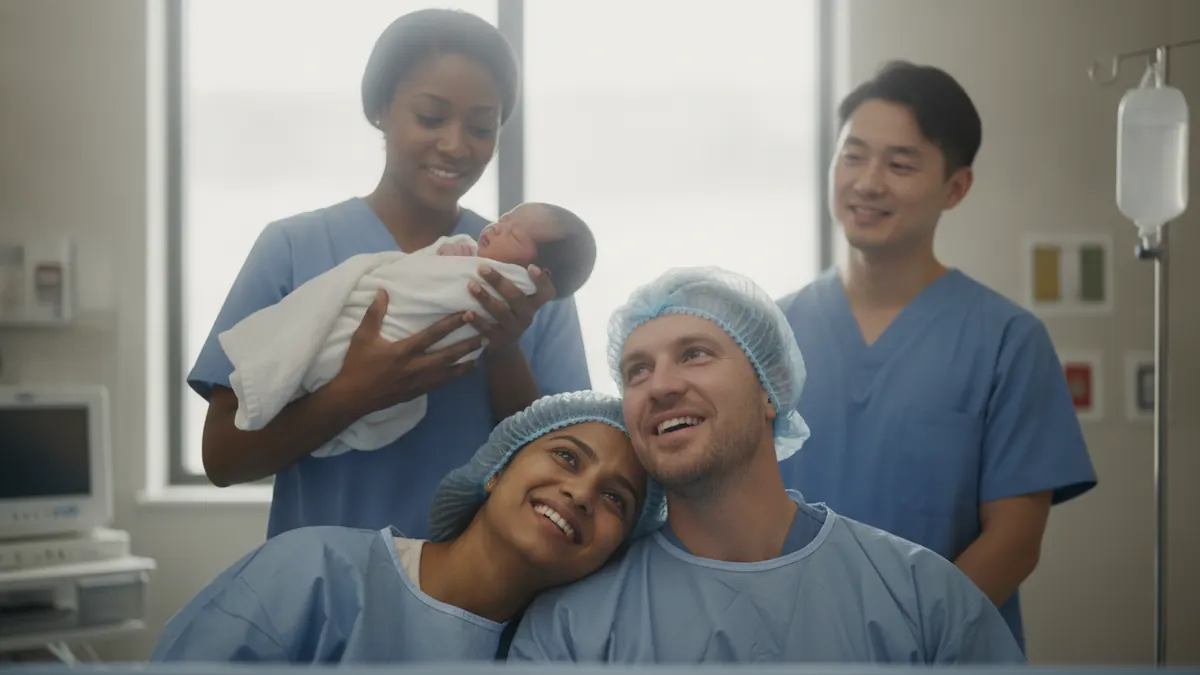
What is a gentle C-section?
A gentle C-section, also called a family-centered cesarean, is not a different operation. The medical and surgical parts of the cesarean remain the same. What changes is how the team handles the atmosphere, the moment of birth, and the first contact between parent and baby.
There is no single medical definition or standard package. ACOG describes family-centered options such as a clear or lowered drape, delayed cord clamping, and early skin-to-skin. Each hospital decides what it can offer based on staffing, equipment, operating room policy, and the medical situation.
The word "gentle" can be uncomfortable because no surgery is automatically gentle, and a traditional cesarean is not a lesser birth. We prefer to think of this approach as making room for connection and parental choice without getting in the way of safe care.
What can you ask for during a family-centered cesarean?
You can ask for any preference that matters to you, but the team may need to change the plan if you or your baby needs urgent care. A short, prioritized list usually works better than a long script.
| Request | What it may look like | What to confirm |
|---|---|---|
| Clear or lowered drape | You can see your baby at the moment of birth. | Ask whether the hospital offers a clear panel, a lowered drape, or both. |
| Delayed cord clamping | The team waits before clamping the umbilical cord when you and your baby are stable. | Ask what timing the hospital uses and when earlier clamping would be necessary. |
| Early skin-to-skin | Your dried, diaper-free baby lies on your bare chest under a warm blanket. | Ask who will position and continuously observe your baby. |
| Partner skin-to-skin | Your partner holds the baby against their bare chest if you cannot. | Ask whether hospital policy and staffing allow it. |
| Music | The team plays music or allows you to bring an approved device. | Check operating room rules, volume limits, and who controls the music. |
| Photos | Your partner or a staff member takes approved photographs. | Ask what can be photographed and when phones or cameras are allowed. |
| Limited separation | Routine newborn care happens close to you when possible. | Ask which checks can happen beside you and which require another area. |
You might also request calm conversation, an explanation before major steps, and your baby being brought close enough for you to see as soon as possible. These sound like small details. In a bright, busy operating room, they can matter a lot. If you want to bring that calm into the operating room, Zen Pregnancy has birth affirmations you can listen to beforehand as relaxation support, for the Apple platform and through Google Play for affirmations.
How does a clear drape C-section work?
A clear drape C-section lets you see the birth through a transparent panel while the sterile barrier remains in place. Another option is for the team to lower an opaque drape briefly as your baby is born.
You do not have to watch. Some parents love the idea, while others know that seeing the surgical area would make them anxious or queasy. You can ask the team to raise the drape again at any point.
A clear or lowered drape may not be possible if there is heavy bleeding, an urgent delivery, an infection-control concern, or a need for rapid newborn care. Surgical preference and hospital policy also matter. Ask what your hospital usually offers rather than assuming the equipment will be available on the day.
Can you have skin-to-skin and delayed cord clamping?
Often, yes. Both depend on you and your baby being stable and on the team being able to maintain safe access to the surgical field.
Early skin-to-skin
Skin-to-skin usually means placing your dried, diaper-free baby face down on your bare chest and covering you both with a warm blanket. A staff member needs to watch your baby's breathing, tone, position, and temperature. Your baby must move for assessment or treatment if there are clinical concerns.
Ask who will help position and observe your baby. This may be a nurse, anesthesia team member, obstetric clinician, or another trained person, depending on the hospital. If you cannot provide skin-to-skin, ask whether your partner can do it.
Delayed cord clamping
ACOG recommends waiting at least 30 to 60 seconds before clamping the cord for vigorous term and preterm newborns. During a cesarean, the surgeon or assistant may hold the baby near the level of the placenta while the team begins drying, stimulation, and temperature care.
Delayed clamping is not always safe. The team may clamp earlier if you need urgent treatment or your baby needs immediate resuscitation.
How do you write a gentle cesarean birth plan?
Keep your gentle cesarean birth plan to one page and list your preferences in priority order. Use flexible language. "If medically safe" is honest and makes clear that you understand plans can change.
You can adapt our birth plan template and add a cesarean section with requests such as these:
- Please explain what is happening before major steps when time allows.
- I would like my chosen support person with me if hospital policy permits.
- I prefer a clear or briefly lowered drape for the birth.
- I would like delayed cord clamping for at least 30 to 60 seconds if my baby and I are stable.
- I would like immediate skin-to-skin with help from a staff member.
- If I cannot have skin-to-skin, please offer it to my partner if permitted.
- Please complete routine newborn care near me when possible.
- I would like approved music and photographs if the operating room team agrees.
Add a backup preference too. For example, if your baby has to leave the operating room, you might want your partner to go with the baby. Hospital policy may affect this, so discuss it beforehand.
Birth planning cannot promise a particular experience. It can stop your preferences from getting lost in the rush. Our hospital bag checklist can help with the practical side of preparing for admission.
How should you raise the plan with your care team?
Bring it up during prenatal care, before the day of surgery if possible. You do not need to wait until your cesarean date is close, and there is no official week when you must ask.
- Tell your OB-GYN or midwife that you are interested in a family-centered cesarean.
- Ask which options the hospital routinely supports and request its written policy.
- Discuss clear drapes, skin-to-skin, delayed clamping, music, photographs, support people, and newborn procedures one by one.
- Ask what medical circumstances would require the team to change the plan.
- Place the final preferences in your medical record and bring a printed copy.
- Review the plan with the obstetric, anesthesia, nursing, and newborn teams before surgery.
A useful question is, "Which parts of this plan can you usually support, and what would make them unsafe?" That invites a more useful answer than a simple yes or no.
If you have a doula, ask what support is allowed in the operating room. Our guide to what a doula does explains where a doula may fit alongside your clinical team.
What happens if the plan has to change?
The team may pause or drop family-centered options if there is heavy bleeding, maternal instability, an urgent birth, or concern about the baby's breathing, tone, or temperature. General anesthesia can also prevent you from being awake and involved at the time of birth.
That can be upsetting, especially if you prepared carefully. It does not mean your plan was pointless. A backup plan can still protect parts of the experience, such as partner skin-to-skin, photographs after stabilization, or bringing your baby to you as soon as clinical care allows.
A gentle C-section does not remove the usual risks of cesarean surgery, including bleeding, infection, blood clots, anesthesia complications, and injury to nearby organs. You will still need practical support and time to heal. Read our guide to C-section recovery before birth so that the first days at home are less of a scramble.
Call your OB-GYN, midwife, or maternity unit urgently after a cesarean for heavy or increasing bleeding, fever, worsening incision redness or drainage, severe pain, chest pain, trouble breathing, fainting, severe headache or vision changes, one-sided leg swelling or pain, or thoughts of self-harm.
What does the evidence say about gentle cesareans?
Evidence for the complete gentle cesarean package is limited. ACOG supports hospitals considering safe family-centered practices, but there is no good evidence that clear drapes, music, or viewing the birth improve medical outcomes.
In one randomized trial cited by ACOG, 72 percent of participants assigned to family-centered care had skin-to-skin contact. That group also reported greater satisfaction and had higher breastfeeding rates than the traditional cesarean group. Because several practices were combined, the trial cannot tell us which one caused the difference.
The most sensible goal is not to turn surgery into a perfectly curated event. It is to reduce avoidable separation, give parents a voice, and protect early contact when the medical situation allows. If you had a cesarean before and hope for a vaginal birth this time, a VBAC class can help you prepare. If your cesarean is planned because your baby is breech, our breech baby pack covers your options.
For structured preparation, The Positive Caesarean Pack has seven lessons covering what to expect, ways to prepare for a calmer operating room experience, and recovery.
Frequently asked questions
Is a gentle C-section safer than a regular C-section?
Current ACOG guidance does not show that the full gentle C-section package is safer. It is a standard cesarean with added family-centered options, so the usual surgical and anesthesia risks remain.
Can I watch my baby being born during a C-section?
You can ask for a clear or lowered drape. The team may change or decline the request because of bleeding, urgency, infection-control concerns, surgical preference, or the need to treat your baby quickly.
Can I play my own music during a cesarean?
You can ask, but there is no universal policy. The answer depends on the hospital, operating room staff, equipment, and whether the team needs quiet for urgent communication.
Can my partner do skin-to-skin after a C-section?
Some hospitals allow partner skin-to-skin when the birthing parent cannot do it and the baby is stable. Confirm the policy beforehand because staffing and operating room rules vary.
Does skin-to-skin mean newborn checks are delayed?
No. Staff can begin drying, observation, temperature care, and some assessments while your baby is with you. They must move the baby if breathing problems, poor tone, low temperature, or another concern requires treatment.
When should I ask about a gentle C-section?
Ask during prenatal care and before a scheduled cesarean when possible. Review the plan again with the hospital team immediately before surgery because staffing and clinical circumstances can affect what is available.
Sources
- ACOG: Approaches to Limit Intervention During Labor and Birth
- ACOG: Delayed Umbilical Cord Clamping After Birth
- NHS Scotland: Gentle Method Caesarean Section
Written by the Zen Pregnancy team for general information. It does not replace advice from your own doctor or midwife.