
Natural birth class for comfort and flexible planning
This natural birth class teaches practical comfort measures, movement, support, and flexible planning for parents hoping to labor without an epidural.
7 lessons · about 1 hour · lifetime access · 30-day money-back guarantee
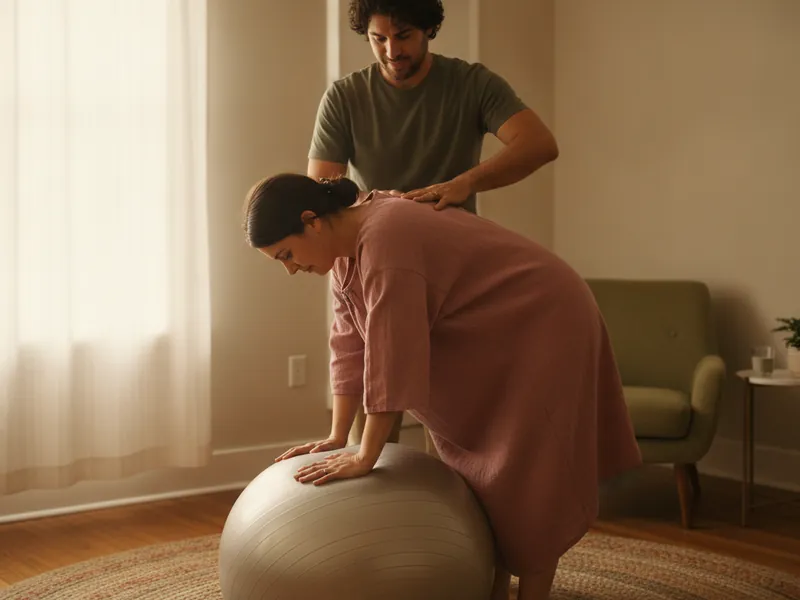
By the end of this course you will
- Understand what unmedicated labor usually feels like and how comfort measures work
- Know which non-drug comfort measures have evidence and which are still uncertain
- Use positions and movement to stay comfortable at each stage of labor
- Set up your birth space and your support team so your body can work calmly
- Write a natural birth plan with a flexible Plan B that respects every choice
This course is for you if
- You hope to labor without an epidural.
- You want evidence explained without hype.
- Your partner needs a clear support role.
- You want a plan that allows for change.
It is not the right fit if
- Anyone looking for a guaranteed pain-free birth.
- Anyone who needs individualized medical advice or emergency guidance.
- Anyone who wants one rigid method that must be followed during labor.
Inside the course
Natural Birth Track is a natural birth class with 7 lessons on comfort options, labor positions, choosing a birth setting, and making a flexible birth plan.
This short track is for parents who hope to labor without an epidural, and for anyone who wants more tools in their toolbox. You will learn what unmedicated birth is like, which comfort measures have real evidence, how positions and movement help, how to shape your birth space and how to write a plan that stays kind to you if things change. It works well beside the hypnobirthing course.
Module 1 · How Comfort Works
- What Unmedicated Labor Feels Like · 7 min
An honest picture of labor sensations, and why preparing your tools matters. - Comfort Measures and What the Evidence Says · 9 min
A fair, source-based look at the most common non-drug ways to ease labor.
Module 2 · Position, Place and Plan
- Positions and Movement Through Labor · 8 min
Positions to try in early labor, active labor and pushing. - Your Space and Your Natural Birth Plan · 8 min
Shape a calm environment, brief your team and keep a kind Plan B. - Build your continuous support team · 8 min
Choose who will stay focused on you during labor, then give each person a clear and useful role. - Rehearse a coping rhythm · 8 min
Practice a short routine that you and your support person can repeat when labor becomes more demanding. - Keep your choices when labor changes · 8 min
Use a flexible decision process when monitoring, induction, pain medication, or another change enters your birth.
Read the start of lesson 1: What Unmedicated Labor Feels Like
Labor without an epidural is a realistic choice, although it is less common than labor with one. CDC data for 2024 show that 24.6 percent of mothers with singleton vaginal births did not use epidural or spinal anesthesia. That figure includes assisted vaginal births and does not tell us which other pain relief methods people used.
The honest version is this. Surges (contractions) can be intense, painful and tiring. Preparation cannot tell you exactly what labor will feel like, and no breathing pattern or mindset can promise a pain-free birth. What preparation can do is give you something useful to try when your thinking brain gets quieter and your body asks for your full attention.
Early surges may feel like menstrual cramps, a tightening across your belly, low backache or pressure in your pelvis. You may still be able to talk, eat, walk or rest through them. They can be irregular, stop for a while and begin again. That uncertainty is often more frustrating than the sensation itself.
The full lesson continues with practices and a checklist inside the course.
What is an unmedicated birth class?
People commonly use "natural birth" to mean labor and vaginal birth without an epidural or spinal anesthesia. The phrase can be imperfect because every birth involves real physical work, and using medication does not make a birth less valid. In this natural birth class, the term describes a preference rather than a standard you have to meet.
CDC data show that 24.6% of mothers with singleton vaginal births in 2024 did not use epidural or spinal anesthesia. That percentage does not cover all US births, and it includes both spontaneous and assisted vaginal births. It gives useful context, but it cannot tell you what will be right or possible in your labor.
Preparation without pressure
An unmedicated birth class should help you understand your options, practice coping methods, and plan support. It should also make room for an epidural, cesarean birth, assisted delivery, monitoring, or other care if your needs change.
- Learn what unmedicated labor may feel like without pretending pain is predictable.
- Choose comfort measures you can practice before labor.
- Give your support person specific jobs.
- Discuss medical preferences and limits with your OB-GYN or midwife.
How do you deal with labor pain without an epidural?
There is no single technique that makes labor comfortable for everyone. Pain varies between people and can change as labor progresses. A practical approach is to prepare several options, try them one at a time, and switch when a method stops helping.
The strongest research support is for continuous one-to-one labor support. Research also suggests benefits from water immersion during the first stage of labor, massage, relaxation, movement, position changes, and possibly acupressure. These methods may help with coping or pain, but none guarantees a birth without epidural.
Build a coping rhythm
A coping rhythm is a repeatable pattern you can return to during contractions. It might combine a position, steady breathing or another relaxation method, touch from your support person, and a quiet pause between contractions. Rehearsing the pattern can make each person's role clearer, even though practice cannot predict how labor will feel.
- Change positions when movement is medically appropriate.
- Ask for massage or firm touch if it feels helpful.
- Discuss access to a shower, tub, or labor immersion with your birth setting.
- Use relaxation or hypnosis as a coping tool, not a promise of pain control.
- Keep medication available as an option rather than treating it as failure.
This course separates better-supported options from methods with limited or mixed evidence. Birth balls, hot compresses, TENS, sterile-water injections, and hypnosis may appeal to some parents, but research has not established dependable comparative effects. Ask your care team which options are available and appropriate for you.
Which support and movement options have evidence?
Continuous one-to-one support has the clearest evidence among non-drug labor measures. The person providing that support can offer reassurance, physical comfort, help communicating preferences, and steady attention. Research found the greatest benefit when the supporter was not a hospital employee and could focus exclusively on the laboring person.
A partner can still be an important part of the team, but research about professional doulas should not automatically be applied to partners, nurses, or volunteer supporters. Think about who can stay present, who knows your preferences, and who can remain calm if plans change.
Movement and position changes
Upright positions, walking, leaning, kneeling, side-lying, and other position changes may support comfort. ACOG recommends frequent position changes when monitoring and treatment remain possible and there are no medical reasons to limit movement. The exact effects on labor length or cesarean birth are less certain across all interventions.
Birth balls and peanut balls can make some positions easier to use, but evidence does not prove that the ball itself reduces pain, shortens labor, or prevents cesarean birth. This distinction matters. A tool may be useful without having a dependable clinical effect.
The natural birth class helps you choose positions, plan how a support person can assist, and consider how your birth setting may affect movement. Your OB-GYN or midwife should advise you if monitoring, treatment, or a medical complication changes what is safe.
How can a natural birth plan stay flexible?
A useful birth plan records preferences without turning them into promises. You can state that you hope to labor without an epidural while also explaining what you would want if you request pain medication, need closer monitoring, or face a change in delivery plans.
Plan for decisions, not a perfect script
- Write down the comfort measures you would like to try first.
- Name the people you want providing continuous support.
- Ask which movement, massage, water, or positioning options your birth setting offers.
- Decide how your support person should respond if you ask for medication.
- Record which choices still matter to you if labor or delivery changes.
For example, you may want your support person to offer a position change and remind you of your coping rhythm before discussing the next option. You may prefer immediate help requesting an epidural instead. Either preference is reasonable, and you can change your mind during labor.
Call your OB-GYN or midwife according to the labor instructions they gave you. Contact them if you are unsure about a symptom, think labor may have started, or have concerns about your baby or your health. Seek urgent medical care when your care team has told you to do so or when something feels seriously wrong.
The course includes a flexible planning lesson because labor does not always follow the expected order. The goal is to protect your ability to ask questions and make informed choices, not to keep an unmedicated plan at any cost.
What does this natural childbirth course teach?
This $19 natural childbirth course has two focused parts. "How Comfort Works" covers what unmedicated labor may feel like and what research says about common comfort measures. "Position, Place and Plan" covers movement, the birth setting, continuous support, coping practice, and flexible planning.
What you will prepare
- A short list of comfort measures you want to try.
- Positions and movement options to rehearse.
- A continuous support team with clear roles.
- A coping rhythm for you and your support person.
- A natural birth plan that still works when care changes.
You can take this natural birth class online instead of searching for local prenatal classes near you. It is also useful alongside the Zen Pregnancy hypnobirthing course. Hypnosis and relaxation can be part of your preparation, but the evidence is uncertain and neither method guarantees pain relief or prevents epidural use.
The course does not replace prenatal care, medical assessment, or advice for your pregnancy. Bring questions about water immersion, movement, monitoring, pain medication, or your individual risks to your OB-GYN or midwife.
Natural Birth Track at a glance
- What it is
- A short online course about unmedicated labor, comfort measures, movement, continuous support, and flexible birth planning.
- Who it's for
- For expecting parents who hope to labor without an epidural or want more ways to cope before choosing medication.
- How long
- 7 lessons, about 1 hour in total. Take it early enough to discuss your preferences with your OB-GYN or midwife and rehearse the techniques with your support person.
- Price
- $19 once, lifetime access, 30-day money-back guarantee. Also included in our bundles.
- Format
- A focused online track that costs $19.

Created with Mariah Shipp, CCHT. Mariah Shipp created and recorded the hypnobirthing and relaxation audio programs used in this course. (Psychology Today profile). She is not a medical doctor; medical information follows ACOG and WHO guidance.
What the research found
- A 2017 analysis of 15 trials involving 12,791 women associated continuous labor support with more spontaneous vaginal births, less analgesia or anesthesia use, and fewer operative deliveries. Cochrane, 2017
- In 2 trials involving 322 women, acupressure reduced labor-pain intensity compared with combined controls, although the benefit may be small. Cochrane, 2020
- A summary of 5 hypnosis trials involving 749 women found lower pain-relief requirements, but the studies were small and used different methods, so the result remains uncertain. Cochrane labor summary
- Among mothers with singleton vaginal births in 2024, 75.4% used epidural or spinal anesthesia and 24.6% did not. CDC NVSS, 2024
Save with a bundle
This course is part of Complete Journey Bundle, together with the full Zen Hypnobirthing Program.
Compare bundlesFrequently asked questions
How can I have a good natural birth?
Prepare several comfort options, arrange continuous support, and write preferences that leave room for medical changes. A good birth is not defined by avoiding an epidural at all costs. Discuss your plan, health needs, and available options with your OB-GYN or midwife before labor.
Can you have a natural birth in a hospital?
Yes. You can plan an unmedicated vaginal birth in a hospital. Ask your OB-GYN or midwife about hospital policies on movement, fetal monitoring, eating and drinking, labor tubs, and support people. Share your birth preferences with the care team, and consider bringing a doula if the hospital allows one. Plans may need to change if you or your baby needs medical care, so discuss your options before labor.
Is there a painless way to give birth?
No method can promise a painless birth. Epidural or spinal anesthesia may be used for pain relief, while non-drug methods can support comfort and coping, but individual experiences vary. Be cautious of any class or technique that guarantees pain-free labor.
How hard is it to have a natural birth?
The difficulty cannot be predicted accurately before labor. Pain, labor circumstances, available support, medical needs, and personal preferences differ. Preparation can give you more options, but changing your plan or requesting medication is not a failure.
What relaxation techniques can be used during labor?
Relaxation may include steady breathing, releasing muscle tension, focused attention, quiet repetition, or self-hypnosis. Research suggests relaxation may help with pain relief or satisfaction, but the evidence is limited and methods differ. Practice with your support person and ask your provider if you have medical concerns.
How can I deal with labor pain without an epidural?
Start with continuous support and keep several comfort measures available. Water immersion during the first stage, massage, relaxation, movement, position changes, and possibly acupressure may help. None guarantees enough relief, so keep discussing your needs and medication options with your care team.
How painful are contractions?
Contraction pain varies widely, so another person's description cannot predict your experience. Comfort may also change during labor and with different positions or support. Prepare more than one coping method, then tell your care team when pain becomes difficult to manage or you want to discuss medication.
Can sitting on the toilet help dilation?
The supplied research does not establish that sitting on a toilet causes cervical dilation. It is one upright position some parents may choose when movement is allowed, but that does not prove a specific effect on labor progress. Ask your nurse, OB-GYN, or midwife which positions are appropriate.
Does this course promise a birth without an epidural?
No. The course prepares you to try comfort measures, movement, continuous support, and a coping rhythm, but it cannot predict labor or guarantee that you will not want or need an epidural. It also helps you keep your preferences clear if your plan changes.
Can I take this natural birth course with the hypnobirthing course?
Yes. This track adds evidence-focused lessons on comfort measures, positions, support, birth setting, and flexible planning. The hypnobirthing course can provide another relaxation tool, but hypnosis has uncertain evidence and should not be treated as guaranteed pain relief.
Courses that go well with this one

The Zen Hypnobirthing Course

Zen Prenatal Yoga

Calm Hospital Birth & Epidural Class
Free guides: Natural birth: how to prepare for unmedicated labor · Birthing positions for labor and pushing · All online prenatal classes